27 Days of Cash: Why Profitable Companies Still Run Out of Money
The median small business holds 27 days of cash; a quarter hold less than two weeks. Profit is an opinion; cash is a fact. Why the P&L keeps surprising owners, and how a 13-week forecast turns month-end panic into a Tuesday-morning routine.
Your P&L says you had a good month. Your bank account disagrees. One of them is lying, and it’s not the bank account.
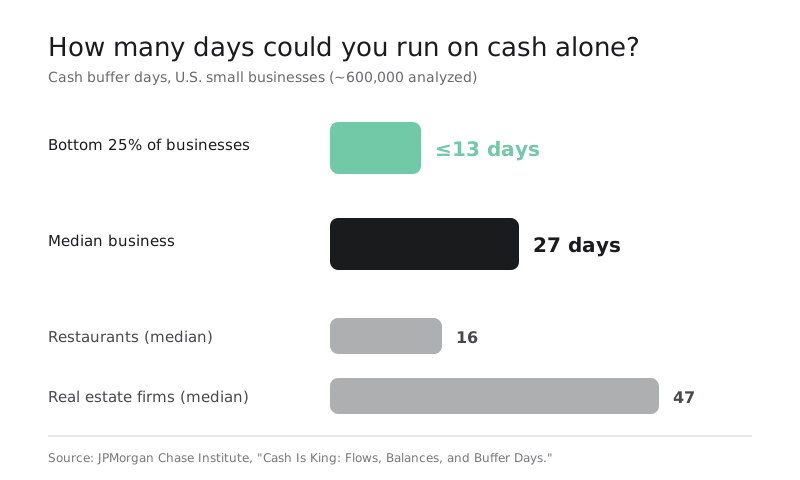
Here is one of the most uncomfortable findings in small business research. The JPMorgan Chase Institute analyzed transaction data from roughly 600,000 small businesses and found the median company holds just 27 cash buffer days, under a month of runway if inflows stopped tomorrow. A quarter of small businesses hold 13 days or fewer (JPMorgan Chase Institute).
Thirteen days. That means for one in four businesses, a single slow-paying customer, one off-cycle tax payment, or one truck transmission is the distance between solvent and scrambling.
And this isn’t a struggling-business statistic. It includes plenty of companies that are profitable on paper. Which is exactly the problem.
Profit is an opinion. Cash is a fact.
The P&L is an accounting document. It records revenue when you earn it, not when the customer pays, and spreads costs across periods in ways that are correct, defensible, and useless for answering the only question that keeps owners up at night: can I make payroll on the 15th?
This is how a business has its best revenue quarter ever and bounces a payment in the same ninety days. You invoiced $400K; the cash arrives in 45-75 days. You hired ahead of the growth; payroll clears every two weeks regardless. Growth consumes cash before it produces any. The faster you grow, the wider the gap.
The failure data says this gap is lethal. Analyses of why small businesses close find 82% of failures involve cash flow problems as a key factor (SMB Compass), not because the businesses weren’t viable, but because the timing of money in and money out was never managed as its own discipline. Recent survey work shows the margin for error is thin everywhere: 39% of small businesses hold less than a month of reserves, and 17% have missed or nearly missed payroll because of late-paying customers (Bluevine).
The three habits that keep owners blind
Inside $5M-$15M businesses, cash surprises almost always trace to the same three habits.
Running the business from the bank balance. The balance tells you where you are, not where you’re going. It’s a speedometer when what you need is a fuel gauge and a map. A healthy-looking balance on the 1st can be a crisis on the 20th. The balance just doesn’t know it yet.
Treating collections as an accounting task instead of a sales discipline. The day your average receivable slips from 35 to 50 days, your business quietly extended hundreds of thousands of dollars in free financing to your customers. Nobody decided this. It happened in the inbox, one un-chased invoice at a time.
Confusing the accountant’s job with the operator’s job. Your CPA closes the books and files the taxes, looking backward, correctly. Forecasting cash is a forward-looking, operational job, and in most businesses this size, it belongs to no one. So no one does it.
The fix is boring, and it works: the 13-week cash forecast
The tool that changes this isn’t software and it isn’t complicated. It’s the 13-week cash flow forecast, the same instrument private equity firms install in week one at almost every company they buy. There’s a reason it’s the first thing the most financially disciplined buyers on earth reach for.
It’s a rolling spreadsheet with a row for every meaningful cash inflow and outflow, projected week by week, one quarter ahead. Thirteen weeks is the magic length: long enough to see a problem coming, short enough to stay honest.
Run properly, it does three things no P&L can:
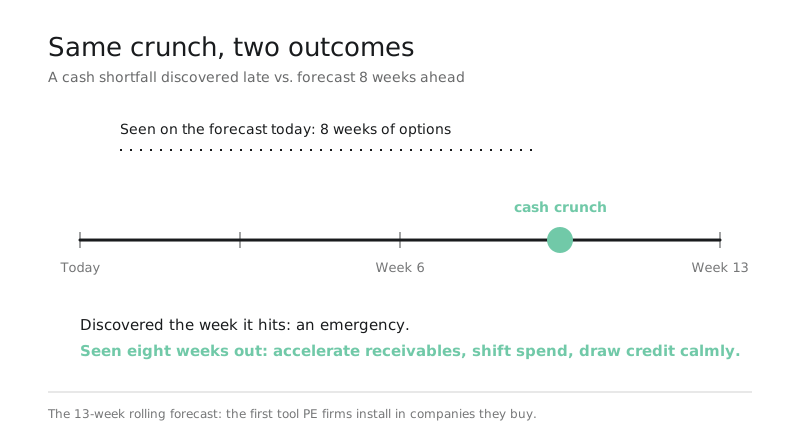
It converts surprises into decisions. A crunch you discover the week of payroll is an emergency. The same crunch seen eight weeks out is a menu of options: accelerate two receivables, shift a purchase, draw the line of credit calmly instead of begging for it urgently. Banks notice the difference.
It exposes the real drivers. Within a month of running one, owners can finally see which customers reliably pay late, which weeks of the month are structurally tight, and what a new hire actually does to the cash line, before making the hire.
It builds the habit of forward-looking finance. The forecast meeting (thirty minutes, every Monday, same three questions: what came in, what went out, what changed in the next 13 weeks) is for many companies the first genuinely forward-looking conversation about money they’ve ever had. It tends not to be the last, because it’s the data layer the whole transformation runs on: pricing, hiring, equipment, expansion all get easier to decide when cash stops being a mystery.
Start this Monday
You don’t need new software, a CFO, or a clean-up project to begin. You need your bank activity, your receivables and payables lists, and an honest hour. The first version will be wrong in places. Every first version is. By week four it will be the most-read document in your company.
And if you’d rather not build it alone, or the books underneath it need work before the forecast can be trusted, that’s squarely the seat we sit in at ARV. Accounting is our foundation, but cash discipline is an operating skill, and our bench has installed it inside businesses exactly your size. Past the panic, there’s a plan.
Sources
- JPMorgan Chase Institute, “Cash Is King: Flows, Balances, and Buffer Days” (analysis of ~600,000 small businesses)
- SMB Compass, “82% of Small Businesses Fail from Cash Flow: The Data”
- Bluevine, “Cash Flow Management Survey” (2026)
Figures are as reported by the sources above. Cash buffer figures reflect medians across industries; your industry’s norm may differ (restaurants median 16 days; real estate 47).