The AI Adoption Gap: Your Competitors Are Using It. Most Are Using It Badly.
Small businesses are now adopting AI faster than large companies, but most are winging it: five disconnected tools, no policy, no link to the numbers. Where AI actually pays off for $5M-$15M businesses, and how to adopt it like an operator instead of a hobbyist.
The question is no longer whether small businesses should use AI. The data settled that. The question is whether yours will use it like an operator or like a hobbyist.
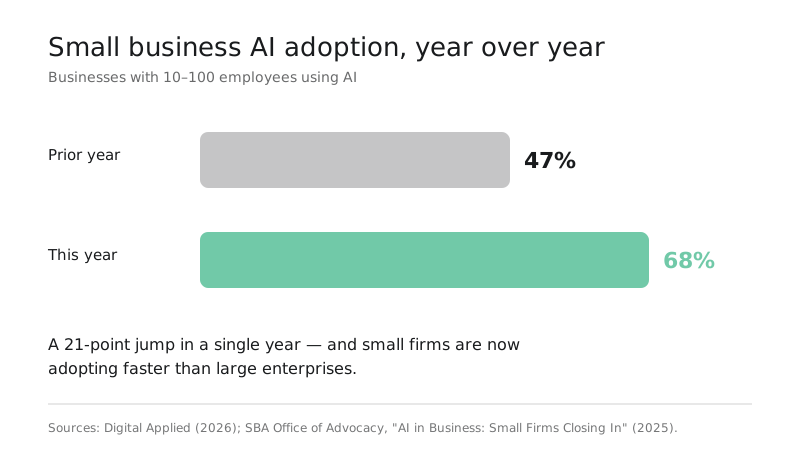
Something unusual happened in the AI adoption data over the past two years, and it should change how owners of $5M-$15M businesses think about the technology: small businesses started adopting AI faster than large enterprises, a reversal researchers at the SBA’s Office of Advocacy had not seen before in this kind of monitoring data (SBA Office of Advocacy).
Adoption among businesses with 10 to 100 employees jumped from 47% to 68% in a single year (Digital Applied). The U.S. Census Bureau now tracks AI use across businesses of every size, and the curve only points one direction (U.S. Census Bureau).
So if you’ve been telling yourself AI is an enterprise game (that it’s for companies with IT departments and seven-figure software budgets), the data says otherwise. Businesses exactly your size are the fastest adopters in the economy right now.
Adopted, yes. Operationalized, almost never.
Here’s the part of the story most coverage skips. The same research that shows 68% of small businesses using AI regularly also shows that 77% have no formal AI policy (Digital Applied). The typical AI-using small business now runs a median of five separate tools (content here, a chatbot there, scheduling somewhere else), working in parallel, connected to nothing (Digital Applied).
That’s not an AI strategy. That’s a junk drawer.
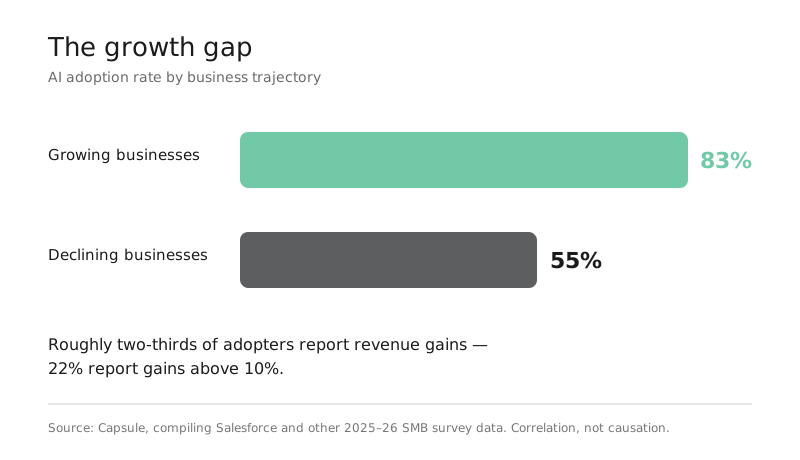
And it matters, because the gap between businesses that adopt deliberately and those that dabble shows up in the revenue line. Survey data compiled across SMB studies found 83% of growing small businesses have adopted AI, against just 55% of declining ones, and roughly two-thirds of adopters report revenue gains (Capsule, compiling 2025-26 SMB survey data). Correlation isn’t causation; growing businesses adopt more of everything. But the pattern is consistent enough that “wait and see” is now the riskier position.
Where AI actually pays off at $5M-$15M
Forget the demos. At your size, with 10-25 employees and no one whose job title contains the word “digital,” AI earns its keep in four unglamorous places.
1. The work nobody bills for
Proposals, follow-up emails, job descriptions, meeting summaries, first drafts of almost anything. This is the most common entry point for a reason: it’s low-risk and the time savings are immediate. If your team writes, an assistant that drafts is the cheapest hour you’ll ever buy back.
2. The inbox and the phone
Customer questions cluster. Most businesses answer the same fifteen questions hundreds of times a year, on the phone, after hours, badly. A well-trained assistant on your website or front line doesn’t replace your people. It absorbs the repetition so your people handle the conversations that actually need judgment.
3. The back office
This is the one we’d point every owner to first, because it’s where AI touches the numbers. Invoice processing, expense categorization, collections nudges, reconciliation prep: the quiet, error-prone work that makes month-end slow and forecasts late. AI doesn’t make these tasks slightly faster; it changes what your bookkeeper and your accountant spend their time on. Cleaner books, sooner, is the foundation every other decision sits on.
4. The owner’s own leverage
The least discussed use case is the most valuable: AI as a thinking partner for the person at the top. Pressure-testing a price increase, summarizing a contract before the lawyer sees it, turning a messy export from your point-of-sale system into an actual answer. Owners who use AI this way describe the same thing: not time saved, but better questions asked.
How to adopt like an operator
Having watched this go well and badly inside real businesses, the difference comes down to four habits.
Start from a business problem, not a tool. “We lose hours to proposal writing” is a project. “We should be using AI” is a mood. Pick the constraint first; the tool selection takes an afternoon.
Write the one-page policy. What data can go into public tools, what can’t, who approves new tools, what gets human review before it leaves the building. This takes an hour, puts you ahead of the 77% who never did it, and prevents the one mistake (client data pasted somewhere it shouldn’t be) that can erase every gain.
Connect it to the numbers. Every AI initiative should have a line it’s supposed to move: hours, days-to-invoice, response time, close rate. If you can’t name the line, it’s a toy. This is also why AI adoption and financial visibility are the same project wearing different clothes. You can’t measure what the tools are doing to a business whose numbers run three weeks behind.
Pilot small, then standardize. One team, one workflow, thirty days, then decide. The five-disconnected-tools junk drawer happens when everyone experiments and nobody consolidates.
The honest bottom line
AI will not transform your business by itself. Nothing does. But the adoption gap is real, it’s measurable, and it’s compounding: the businesses using these tools deliberately are getting faster and cheaper at the exact work that slows everyone else down.
At ARV, this is the kind of problem we like, because it’s not really a technology problem. It’s an operating problem with a technology component, and it runs on the same data layer everything else runs on: numbers you can trust. If you want operators who’ve actually wired this into businesses your size, not a deck about “digital transformation,” we should talk.
Sources
- U.S. Census Bureau, “AI Use at U.S. Businesses” (May 2026)
- SBA Office of Advocacy, “AI in Business: Small Firms Closing In” (September 2025)
- Digital Applied, “Small Business AI Adoption: 68% Use It, Most Wing It”
- Capsule, “Small Business AI Adoption Statistics” (compiling Salesforce and other 2025-26 SMB surveys)
Figures are as reported by the sources above; survey methodologies and definitions of “AI use” vary.