You Don't Have an AI Problem. You Have a Workflow Problem.
Most owners your size are now paying for AI. Almost none are getting real money out of it. The gap isn't the technology — it's that nobody rewired how the work actually gets done. Here's what the companies pulling ahead do differently, and where to start.
You signed up for the tools. Maybe five of them. The P&L looks exactly the same. That’s not a technology failure — it’s an operating one, and it’s the most common mistake owners your size are making right now.
Here’s the conversation we keep having. An owner tells us they’ve “gotten into AI.” They’ve got a chatbot writing marketing copy, a note-taker in every meeting, something that drafts emails, a tool the sales rep swears by. When we ask what any of it has done for margin, throughput, or the number of hours the business needs from them personally — the answer is a shrug. It feels productive. It photographs well. But nothing downstream actually changed.
You are not behind for feeling that way. You’re right on schedule. And the fix is more within your control than the noise online would suggest.
The adoption number is real. The value number isn’t.
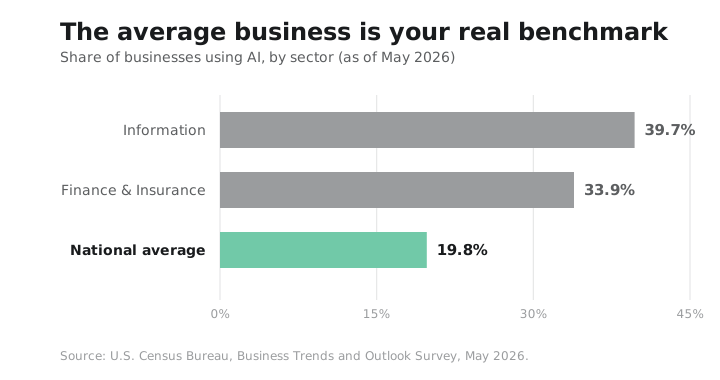
Start with the good news, because it’s genuinely good: businesses like yours are adopting. As of May 2026, roughly one in five U.S. businesses reported using AI in the prior two weeks, and another 20–23% expect to start within six months, according to the Census Bureau’s Business Trends and Outlook Survey. Notably, the growth is concentrated in firms with 20 or more employees — companies right in your neighborhood — while the very smallest shops have barely moved.1
So you’re in the wave. The problem is what happens after you join it.
McKinsey’s most recent State of AI research puts a hard number on the letdown. Across organizations, 88% now use AI in at least one business function. But only about a third have moved past pilots, only 39% can point to any measurable impact on their bottom line, and just 6% qualify as genuine “high performers” capturing real enterprise value.2 Read that again. Nearly everyone is using it. Almost no one is getting paid for it.
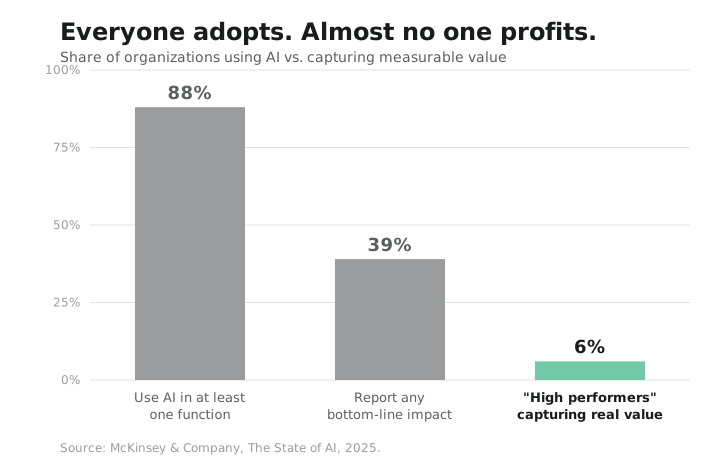
That collapse — from “everybody’s using it” to “almost nobody’s profiting” — is the whole story. And it’s not because the tools are bad. It’s because most companies bolted them onto workflows that were designed for a world without them.
”AI theater” is the trap
McKinsey has a blunt name for the gap between activity and results: AI theater. Going through the motions of adoption — buying licenses, running demos, letting everyone play — without ever rewiring how the work moves through the building.2
It’s an easy trap because the tools are built to be easy. You can have a small business running a median of five different AI tools inside a quarter, per the Upwork Research Institute’s 2026 SMB survey.3 Five tools, zero redesigned processes. Each one shaves a few minutes off a task that a person still owns, still checks, still hands off the same way they did last year. The minutes are real. They just never add up to anything you can see from the top, because the shape of the work didn’t change — only the typing got faster.
Think about how a quote actually gets produced in most $8M shops. A lead comes in, someone reads it, someone pulls history, someone drafts a number, someone reviews it, someone sends it, someone chases it. Drop an AI writing tool into step four and you’ve made one person’s afternoon slightly nicer. The lead still waits days. The bottleneck was never the drafting.
What the 6% do differently
The companies pulling real money out of AI aren’t smarter or richer. They do one thing the other 94% don’t: they redesign the workflow around the tool instead of the other way around. McKinsey found workflow redesign to be the single factor most correlated with actual bottom-line impact — more than model choice, more than spend, more than which vendor you picked.2
In practice that means three unglamorous moves.
They pick one workflow — not “AI for the company.” One process that’s slow, repetitive, and touches money: quoting, invoicing and collections, onboarding a new customer, scheduling, first-pass customer service. Something you could describe on a napkin.
They redesign the whole path, not one step. They ask what the process would look like if it were built today, with these tools available from the start — and they’re willing to delete steps, not just speed them up. That’s the part that pays. A tool that drafts the quote is a convenience. A quoting process where the draft, the pricing check, the approval, and the send happen in one flow while the customer’s still warm is a different business.
They set an outcome and measure it. Not “we’re using AI.” A number: quote turnaround from four days to four hours, DSO down five days, onboarding from two weeks to two. If you can’t name the number the redesign is supposed to move, you’re doing theater, and it’s better to know that now.
This is an owner-dependence story, too
There’s a second reason to care, and it’s the one that keeps owners your size up at night: the business needs too much of you.
The workflows most worth redesigning are usually the ones still running through your head — the pricing judgment, the “let me just look at it before it goes out,” the exceptions only you know how to handle. Those are exactly the places where a redesigned, AI-assisted process can finally get the work out of you and into a system. Not to remove judgment, but to capture it once and let it run, so the business stops routing every non-standard decision back to the founder.
Done right, this is less “adopt AI” and more “build the operating system you were going to need at $15M anyway.” The tool is just what makes the redesign affordable now instead of after your next big hire.
Where to start this quarter
You don’t need a strategy offsite. You need to pick one process and be honest about it.
Map how it works today — every handoff, every wait, every place it lands back on your desk. Find the step where time actually disappears (it’s rarely the one you’d guess). Then redesign the whole path assuming the tools exist, delete what you can, and put one number on the outcome. Run it for a month against that number. If it moves, do the next process. If it doesn’t, you’ve spent a month and learned where the real constraint lives — which is worth more than another license.
That’s it. That’s the work. It’s not exotic, and it’s not really about AI. It’s operations — the same discipline that separates a company that scales from one that just gets busier.
Beyond the tools
At ARV, we start with your numbers because the numbers tell you which workflow is actually costing you — which is where any redesign should begin. But the work rarely stops at the ledger. Untangling how a quote gets made, where cash gets stuck, or which decisions still route through the owner is an operations problem, and it’s the kind of thing our bench does alongside you.
The firms that win the next few years won’t be the ones with the most AI tools. They’ll be the ones that changed how the work gets done. That’s a decision, not a purchase — and it’s one you can start making this quarter.
Sources
Footnotes
-
U.S. Census Bureau, “AI Use at U.S. Businesses” (Business Trends and Outlook Survey), May 26, 2026. National AI-use rate of 19.8% as of May 3, 2026; overall usage held between 17–20% from December 2025 to May 2026, with 20–23% expecting to adopt within six months; growth concentrated among firms with 20+ employees; Information sector 39.7% and Finance and Insurance 33.9%. https://www.census.gov/library/stories/2026/05/ai-use-businesses.html ↩
-
McKinsey & Company, “The State of AI,” 2025. 88% of organizations report using AI in at least one business function; only about one-third have scaled beyond pilots; 39% report measurable bottom-line (EBIT) impact; ~6% are “high performers”; workflow redesign identified as the factor most correlated with value capture; “AI theater.” https://www.mckinsey.com/capabilities/quantumblack/our-insights/the-state-of-ai ↩ ↩2 ↩3
-
Upwork Research Institute, “The State of AI Within SMBs in 2026” (survey of 750 U.S. business leaders, Q1 2026). Small businesses use a median of five AI tools. https://www.upwork.com/resources/state-of-ai-in-smbs ↩