The Cost of Chasing New Customers Keeps Climbing. Your Best Growth Is Already on the Books.
The price of winning a new customer has roughly tripled in under a decade, and the ad meter keeps running. Meanwhile the cheapest, highest-odds growth you have is sitting in your existing customer list — most owners just aren't measuring it. Here's how to find it.
The price of winning a brand-new customer has roughly tripled in under a decade, and every channel you’d use to find one is getting more expensive by the quarter. Meanwhile the cheapest, highest-odds growth you own is sitting quietly in your existing customer list — and most owners can’t even tell you what it’s worth.
Here’s a conversation we have with owners more often than you’d guess. Revenue is flat or growing slowly, so the instinct kicks in: we need more leads. More ad spend, a new agency, another salesperson, a bigger top of the funnel. It feels like the obvious lever, because for years it was. Buying attention used to be cheap, and throwing money at growth more or less worked.
That era is over, and the math has quietly turned against it. If your growth plan is “spend more to find more strangers,” you’re paying premium prices for the hardest sale you can make — while the easiest one goes unworked.
The new-customer meter has been running
Start with what it actually costs to acquire someone who has never bought from you. The research firm SimplicityDX tracked the full economics of winning an e-commerce customer and found that in 2013, merchants lost an average of $9 on each new customer they acquired once you netted out acquisition and returns. By 2022 that loss had ballooned to $29 — a 222% increase in eight years. (SimplicityDX) Acquisition costs were the single biggest driver.
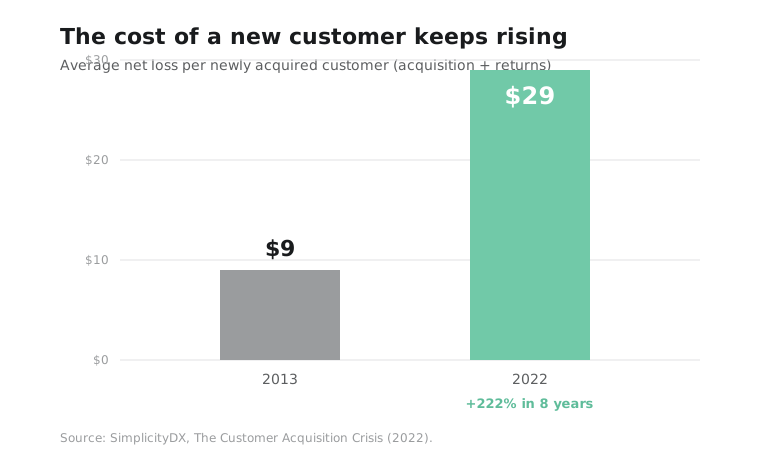
That’s e-commerce, but the force behind it touches every business that markets itself: more competition for the same eyeballs, tighter ad targeting after years of privacy changes, and platforms that have learned exactly what your attention is worth. The number isn’t an anomaly. It’s the trend line, and it points up.
The deeper problem for an owner is that acquisition cost is a treadmill. You don’t pay it once. You pay it every time you want to grow, and the price goes up while you stand still.
And the channels you’d use cost more every year
Maybe you don’t sell online. It doesn’t matter — the auction you’d buy into is inflating regardless. In 2025 the average cost per click in Google Ads rose 12.9% year over year, with prices climbing in 87% of industries. (WordStream) On the social side it’s worse: Meta’s average CPM — the cost to put your ad in front of a thousand people — jumped about 20% in a year, and the cost to actually acquire a customer through Meta rose nearly 38%. (AdAmigo)
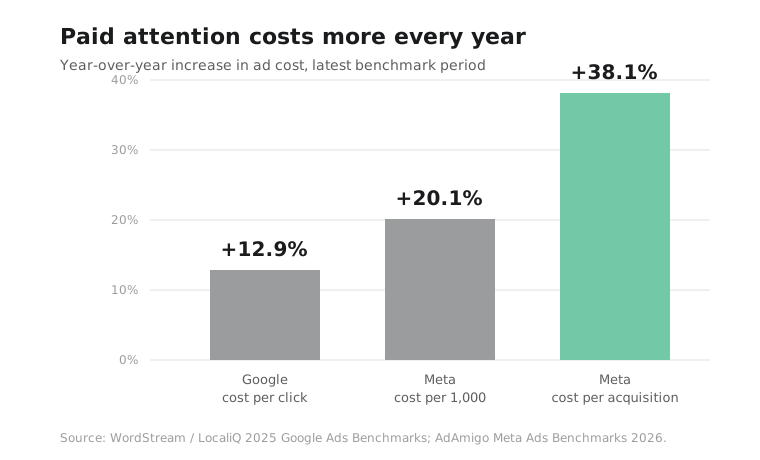
Read those numbers as an owner, not a marketer. They mean that the exact same campaign you ran last year, with the same creative and the same targeting, costs materially more this year to produce the same result. Your customer acquisition cost goes up even when you do nothing differently. If your revenue is flat, your true cost of growth may already be rising underneath you — you just don’t see it, because it’s buried inside a marketing line you treat as fixed overhead.
This is the trap. Owners respond to a soft quarter by pouring more into the most expensive, least certain channel they have, right as that channel is repricing against them.
The asset you already paid for
Now flip the board over. You have a list of people who have already bought from you, already trust you, and already know your name. You paid full acquisition price for every one of them. The question almost no owner can answer is: what is that list actually worth, and how hard are we working it?
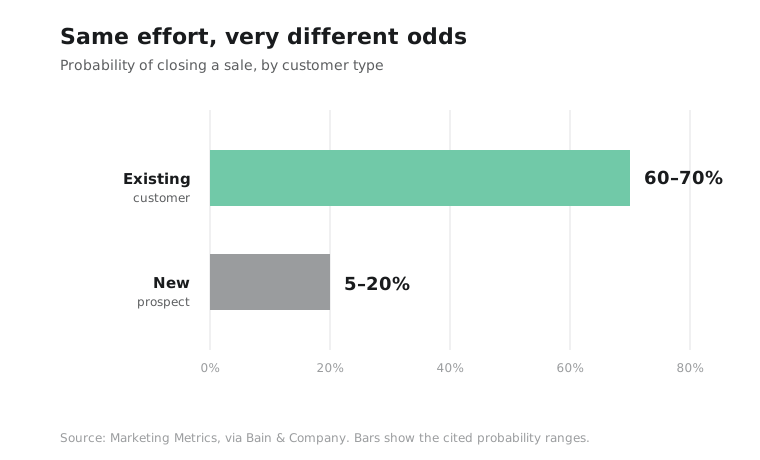
The economics here are not close. According to the figures marketers have leaned on for years — popularized in the book Marketing Metrics and cited by Bain — the probability of selling to an existing customer is 60–70%, while the probability of selling to a brand-new prospect is just 5–20%. (Bain & Company) Same effort, three to ten times the odds.
And the payoff compounds. The foundational research on this — from Fred Reichheld at Bain, the person who later invented the Net Promoter Score, reported in Harvard Business Review — found that increasing customer retention by just 5% increases profits anywhere from 25% to 95%. (Harvard Business Review) Not revenue — profit. Because a retained customer costs almost nothing to serve again, buys more over time, and sends you referrals you never had to advertise for.
Put the two pictures side by side. New customers: getting more expensive every quarter, with a one-in-five chance of closing. Existing customers: already paid for, two-in-three odds, and a 5-point retention gain that can nearly double your bottom line. The growth you’re chasing is the worst deal on the table. The growth you’re ignoring is the best.
Why good owners miss this
It isn’t a smarts problem. It’s a measurement problem, and it’s structural.
Most $5M–$15M businesses track the things that are easy to count: total revenue, new leads, jobs booked, units shipped. Almost none of them track the two numbers that would actually settle the new-versus-existing debate — what it truly costs to acquire a customer (CAC), and what a customer is worth over their lifetime (LTV). Without those, “spend more on marketing” feels like progress because you can see the leads going up. The fact that each lead is costing more and converting worse is invisible, because nobody’s calculating it.
Retention is even easier to ignore because nothing breaks when you neglect it. A customer who quietly stops buying doesn’t file a complaint. They just don’t come back, and the gap gets papered over by the new logos you bought at premium prices to replace them. You’re running up a down escalator and calling it growth.
What to do instead
None of this means stop marketing or stop acquiring. New customers are oxygen. It means stop treating acquisition as your only growth lever, and start working the asset you already own. Four concrete moves:
Know your real CAC and LTV. Take total sales-and-marketing spend over a period, divide by new customers won, and you have your true acquisition cost — usually higher than owners guess. Then estimate what an average customer spends over the life of the relationship. The ratio of those two numbers tells you whether you’re building value or buying it at a loss. This is a one-afternoon exercise that reframes every budget decision after it.
Find the leak before you pour in more. Look at how many customers bought once and never returned. That repeat rate is your retention telling you the truth. A modest improvement there — Reichheld’s 5 points — is worth more to your profit than a comparable bump in new leads, and it costs a fraction as much.
Build a deliberate engine for repeat and referral. Most repeat business at your size happens by accident. A simple, consistent follow-up rhythm — a check-in after the sale, a reason to come back, an easy way for happy customers to refer — converts at those 60–70% odds instead of the 5–20% you pay top dollar for.
Reallocate, don’t just add. Before approving a bigger ad budget, ask what the same dollars would return if aimed at keeping and growing the customers you already have. Often it’s the higher-return move, and you can prove it once you have the CAC and LTV numbers in hand.
Where this lands
The owners who win the next few years won’t be the ones who outspend everyone on attention that keeps getting pricier. They’ll be the ones who actually know their numbers — what a customer costs, what a customer is worth, and where the relationship is leaking — and who put their next dollar where the odds and the math are on their side.
That’s the kind of question that lives in the seam between marketing, finance, and operations, which is exactly where most small businesses have no one sitting. At ARV, it’s the bench we deploy: helping owners pin down real CAC and LTV, find the retention leaks, and aim the growth budget where it compounds. It starts with accounting, but the answer here was never just an accounting answer. That’s the point of going beyond it.
Sources
- SimplicityDX, The Customer Acquisition Crisis (2022) — net loss per new customer rose from $9 (2013) to $29 (2022), a 222% increase. https://www.simplicitydx.com/blogs/customer-acquisition-crisis
- WordStream / LocaliQ, 2025 Google Ads Benchmarks — average CPC up 12.9% year over year, rising in 87% of industries. https://www.wordstream.com/blog/2025-google-ads-benchmarks
- AdAmigo, Meta Ads CPM & CPC Benchmarks 2026 — Meta CPM up ~20.1% and CPA up ~38.1% year over year. https://www.adamigo.ai/blog/meta-ads-cpm-cpc-benchmarks-by-country-2026
- Marketing Metrics, via Bain & Company — probability of selling to an existing customer 60–70% vs. 5–20% for a new prospect. https://www.bain.com/insights/retaining-customers-is-the-real-challenge/
- Frederick Reichheld / Bain & Company, via Harvard Business Review, The Value of Keeping the Right Customers (2014) — a 5% increase in retention raises profits 25%–95%. https://hbr.org/2014/10/the-value-of-keeping-the-right-customers