Google Used to Send You Customers. Now It Keeps Them.
For years, search quietly fed your business — someone had a question, Google sent them to your site, some of them became customers. That pipe is narrowing fast. AI now answers the question on the results page, and the click never happens. Here's what's actually changing, and the three moves that still bring customers in.
For years, search quietly did sales work for you. Someone typed a question, Google pointed them at your website, and a slice of those visitors turned into customers. That pipe is narrowing fast — AI now answers the question right on the results page, and the click never happens. This is the shift most owners your size haven’t priced in yet.
Pull up your website analytics and look at organic traffic over the last eighteen months. A lot of owners we talk to see the same shape: flat, then a soft downward drift that doesn’t line up with anything they did. Same content, same rankings, fewer visitors. It’s easy to write off as a slow month, a seasonal dip, a Google tweak. It isn’t. It’s the single biggest change to how customers find businesses since the smartphone, and it’s happening quietly enough that most owners won’t name it until the leads are visibly down.
Here’s the plain version: the search box has turned into an answer box. And an answer box doesn’t send traffic anywhere.
The click is disappearing, and the data isn’t subtle
Start with the most credible read available. In July 2025, the Pew Research Center published an analysis of nearly 69,000 real Google searches from a panel of U.S. adults who agreed to share their actual browsing. The finding was clean: when an AI-generated summary appeared at the top of the results, users clicked a traditional search link just 8% of the time. When no AI summary appeared, they clicked nearly twice as often — 15%. And a link inside the AI summary? Clicked in only 1% of visits (Pew Research Center).
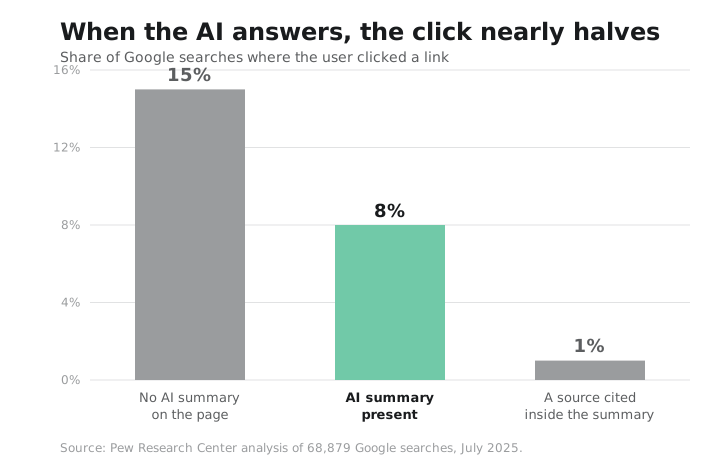
Read that again, because it’s the whole ballgame. The AI reads your website, summarizes what you know, and hands the answer to your prospective customer — who now has no reason to visit you. Pew also found people were more likely to end their search session entirely after seeing an AI summary (26% of the time, versus 16% without one). They got what they came for. They’re done.
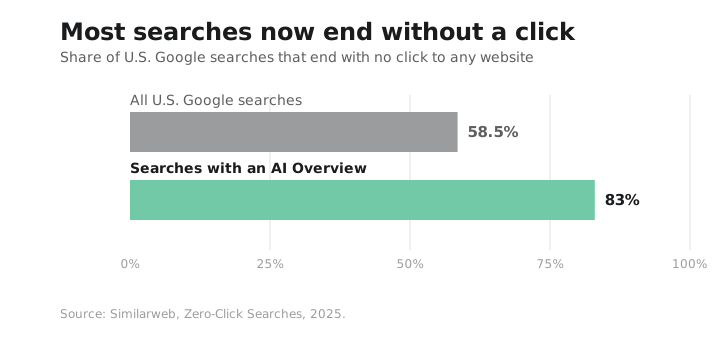
This isn’t a fringe feature anymore. In Pew’s data, about one in five searches already produced an AI summary, and roughly six in ten people encountered at least one in a single month — back in early 2025. It has only spread since. Zero-click searches — the ones that end without the user visiting any website at all — now make up around 58% of U.S. Google searches, and when an AI Overview is present that figure jumps to roughly 83%, according to Similarweb (Similarweb).
And ranking well no longer saves you. Ahrefs studied 300,000 keywords using Google Search Console data and found that AI Overviews now cut the click-through rate for the top-ranked page by 58% — meaning even the businesses that “won” the search result are watching more than half their clicks evaporate before anyone reaches their site (Ahrefs).
Why this lands harder on a business your size
You might think this is a publisher problem — news sites and blogs losing ad traffic. Some of it is. But the mechanism hits a $5M–$15M business squarely, for two reasons.
First, a lot of how your customers find you starts as an informational question. “How much should X cost?” “What’s the difference between Y and Z?” “Do I need a permit for…?” Those research queries are exactly the ones AI is most eager to answer in full, because they’re answerable in a paragraph. That top-of-funnel — the stranger who didn’t know your name yet but had a problem you solve — is the part drying up first.
Second, you don’t have the brand gravity to absorb it the way the giants do. The same research shows the very largest, best-known sites are holding steady or even growing their share, while the sharpest declines fall on everyone in the long middle — the regional, the specialized, the merely-very-good. That’s most companies your size. The customer who already knows your name will still type it in. The one who didn’t may never get the chance to learn it.
None of this means your website is worthless or that search is dead. It means the free, passive customer acquisition that search quietly provided for a decade is shrinking, and the businesses that keep growing will be the ones who noticed early and rebuilt their front door somewhere they actually control.
Three moves that still bring customers in
This is a distribution problem, not a website problem — so the fixes are about where your next customer comes from, not what font your homepage uses. Three of them are worth your attention this quarter.
Own the channels the algorithm can’t take away. Every customer relationship that lives in an inbox, a phone, or a repeat-purchase history is one that no search change can touch. If you don’t have a real, used email list of past and current customers, that’s the highest-return marketing project available to you right now — not because email is exciting, but because it’s yours. The traffic you rent from Google can be repriced overnight, as you’re now watching happen. The list you own can’t. Your best growth was always the customers already on your books; that’s more true this year, not less.
Become the answer, not just a page in the results. The AI has to summarize something. Increasingly it pulls from sources it reads as authoritative and specific — clear, expert content that answers a real question directly, plus third-party signals like reviews, directory listings, and being mentioned on sites the model trusts. Pew found the sources cited most often in AI summaries were the ones with dense, structured, reference-grade information. Practically: publish the genuinely useful answers your salespeople give every day, get your business complete and reviewed everywhere customers check, and aim to be the specific source the AI quotes — because being named in the answer is the new version of ranking first. It’s early, the rules are unsettled, and that’s exactly why there’s room to get in front of competitors who are still waiting.
Compete on reputation, because that’s the click that survives. When someone does reach the point of choosing a vendor, they search your name — and what they find is reviews, referrals, and word of mouth. Those “branded” and human-recommended paths are the traffic AI can’t intercept, because they start with intent to buy from you specifically. Referral programs, a deliberate review habit, showing up where your industry actually gathers, doing work worth talking about — the unglamorous reputation work is now some of the most defensible marketing you can do.
The number that should change
If you take one thing from this, make it a question for your next leadership meeting: where did our last twenty customers actually come from? Not “we get traffic from Google” — the specific path each real customer walked. Most owners have never traced it, and in a normal year they could get away with that. This isn’t a normal year. When the biggest passive channel in your marketing mix is quietly shrinking, knowing which channels still produce paying customers — and what each one costs you — stops being a nice-to-have and becomes the difference between reacting in a panic next spring and moving deliberately now.
Beyond the click
At ARV, we start with your numbers, and this is a place where the numbers cut through the noise fast. Pull your traffic trend, your lead sources, and your true cost to acquire a customer by channel, and the picture stops being anxious guesswork and becomes a decision: where to lean in, what to stop paying for, which owned channel to build. That’s the kind of work our bench does alongside owners — connecting what’s happening in the market to what’s actually moving your growth, and then helping you do something about it.
Search spent a decade sending you customers for free. That era is closing. The businesses that come out ahead won’t be the ones who chased the algorithm — they’ll be the ones who built a way to reach customers that no algorithm gets to vote on. That’s a decision you can start making this quarter.
Sources
- Pew Research Center, “Google users are less likely to click on links when an AI summary appears in the results,” July 22, 2025 — analysis of 68,879 unique Google searches from 900 U.S. adults. pewresearch.org
- Similarweb, “Zero-Click Searches and How They Impact Traffic,” 2025 — roughly 58.5% of U.S. Google searches end without a click; ~83% when an AI Overview is present. similarweb.com
- Ahrefs, “New Research: Google’s AI Overviews Now Cost Websites 58% of Their Clicks” (via Business Wire), May 2026 — analysis of 300,000 keywords finding AI Overviews cut top-ranking click-through rate by 58%. businesswire.com