The Line Item You Stopped Reading Is Eating Your Margin
Small-group health premiums are set to climb 11% in 2026 — the steepest in over a decade — a federal subsidy cliff lands in January, and liability rates keep grinding higher. For owners between $5M and $15M, insurance has quietly stopped being a fixed cost. Here's what you still control.
Small-group health premiums are set to climb 11% in 2026 — the steepest in over a decade — a federal subsidy cliff lands in January, and liability rates keep grinding higher. For owners between $5M and $15M, insurance has quietly stopped being a fixed cost. Here’s what you still control.
Every year the renewal email arrives, the number is a little bigger, and you sign it. It’s a nuisance, not a decision. You negotiate hard on your lease, you scrutinize a new hire, you’ll argue over a vendor’s 6% price bump — but insurance? Insurance is just weather. It happens to you.
That reflex is starting to cost real money. In January 2026, 13% of small-business owners told the NFIB that the cost or availability of insurance was their single most important problem — the highest that reading has been since December 2018, and up four points in a single month (NFIB). When a cost you’ve trained yourself to ignore becomes the thing owners lose the most sleep over, it’s worth reopening the envelope.
The number behind the number
Start with health coverage, because for most owners it’s the biggest and the fastest-moving piece. Across 318 small-group insurers filing in all 50 states, the median proposed premium increase for 2026 is 11% — one of the largest single-year jumps in more than a decade. The spread is wide: filings run from a 5% decrease to a 32% increase, and while most land in the 5%–15% band, roughly one insurer in ten is asking for 20% or more (Peterson-KFF).
The drivers aren’t mysterious, and they aren’t going away. Carriers point to the same forces you feel everywhere else: higher hospital and physician prices, drug costs, and utilization. One newer line item is worth naming — GLP-1 weight-loss drugs came up in 27 of 96 insurer filings that KFF reviewed in detail, enough that some carriers are excluding them to hold rates down. This is a structural cost trend, not a one-year blip.
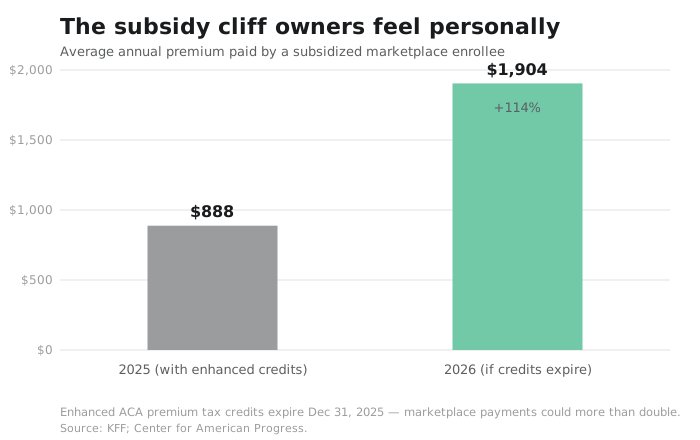
If you don’t offer a group plan and your family buys coverage on the marketplace instead — a common setup for owners in this revenue band — there’s a second shoe. The enhanced premium tax credits that have quietly held down marketplace costs since 2021 are set to expire December 31, 2025. If Congress doesn’t act, roughly 4.4 million small-business people face an average premium increase of about $1,500 for 2026, and the average subsidized enrollee’s annual payment could more than double — from about $888 to $1,904 (Center for American Progress; KFF). That’s not an HR footnote. For an owner-operator, it’s a direct hit to take-home pay landing the same quarter your group renewal does.
It’s not just health — the whole risk ledger is moving
Here’s the part that catches owners off guard: the commercial side of your insurance isn’t moving in one direction. It’s splitting in two.
Property coverage is actually easing. In the first quarter of 2025, commercial property rate increases moderated to 2.9%, less than half the 6.0% of the prior quarter, as carriers turned more competitive (CIAB). If your renewal is property-heavy — a building, equipment, inventory — this is the best negotiating position you’ve had in years.
Liability is going the other way. In that same survey, commercial auto rate increases jumped to 10.4% and umbrella liability to 9.5%, both accelerating. The culprit isn’t your driving record — it’s what the industry calls social inflation: larger jury awards and the rise of third-party litigation funding, where outside investors bankroll lawsuits in exchange for a cut of the payout. If you run trucks, vans, or anything with wheels and a logo, your fastest-rising insurance cost has nothing to do with anything you did.
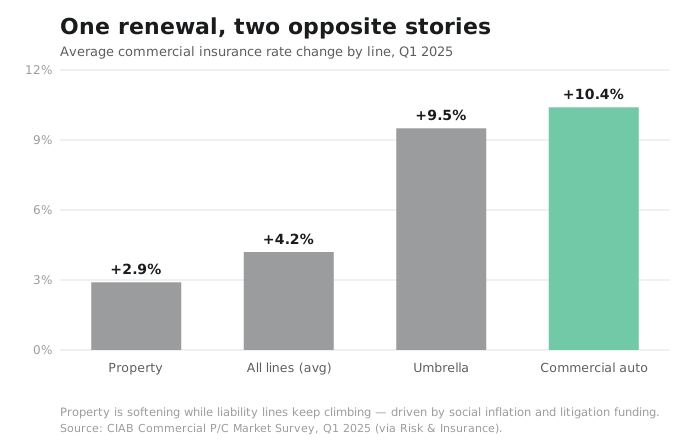
The takeaway isn’t “everything is up.” It’s that a single blended renewal number hides two opposite stories — and if you treat the whole bill as one immovable object, you’ll overpay on the line that’s softening and get blindsided by the one that isn’t.
Why this is a finance problem, not an insurance problem
Most owners file insurance under “stuff the office manager handles.” That was fine when premiums drifted up 3% a year and rounded away. At 11% on health and double digits on liability, the math changes.
Run it on your own P&L. If insurance — health, liability, property, workers’ comp — runs 4% to 6% of revenue for a company doing $8M, that’s $320,000 to $480,000. A blended 10% increase is $32,000 to $48,000 straight off the bottom line in a single year. For a business netting 8%, you’d need roughly $400,000 to $600,000 in new sales just to stand still against that one increase. Nobody celebrates the renewal that ate a whole salesperson’s quota.
This is why insurance belongs in your FP&A conversation, not just your benefits meeting. The middle-market firms that are handling 2026 well aren’t the ones cutting coverage — they’re the ones treating it as a managed cost. In CBIZ’s Q1 2026 read of the middle market, 84% of businesses said they were prioritizing cost optimization and productivity (CBIZ). Insurance is the largest cost most of them still manage on autopilot.
What you actually control
You can’t vote on drug prices or jury awards. But more of this line is within reach than the renewal email lets on.
Start the renewal 120 days out, not 30. The single biggest source of overpayment is time pressure. When you’re a week from expiration, your broker has no leverage and neither do you. Ask for the renewal early, get claims data in hand, and give yourself room to market the account. On property especially, where carriers are competing again, that runway is worth real dollars.
Unbundle the blended number. Make your broker show you each line separately — property, auto, umbrella, health — with its own rate change and its own justification. You’ll find the softening lines you should be pushing on and the climbing lines you need a plan for. A single percentage across everything is designed to be signed, not questioned.
Look hard at plan design before you cut people’s coverage. Level-funded and self-funded arrangements, tighter networks, HSA-qualified plans, and — for some owners — captives or association health plans can change the trajectory without gutting the benefit. These aren’t right for everyone, and the wrong one adds risk. But at 11%, “we’ve always been fully insured” deserves an actual analysis, not a shrug.
Treat claims and safety as a cost lever. On liability and workers’ comp, your loss history is your price. Documented safety programs, telematics on vehicles, and clean claims records are the difference between renewing flat and renewing up double digits. Carriers reward businesses that look boring to underwrite.
Model it into your pricing. If your insurance line is climbing 10% and you reprice once a year out of habit, you’re financing the gap yourself. Build the real cost trend into how you price your own work — quietly, deliberately, the way the disciplined operators in your market already do.
The point isn’t to panic. It’s to pay attention.
None of this means insurance is a crisis. Property is softening. Optimism among small-business owners is still holding up. The point is narrower and more useful: the era when you could sign the renewal without reading it is over, and the owners who notice first will keep money the rest leave on the table.
Reopen the envelope. Ask the second question. Put the biggest cost you’ve been ignoring back on the same footing as every other decision you actually make.
This is exactly the kind of cost most owners never staff for — too big to ignore, too specialized to hand to the office manager. At ARV, we start with the numbers and bring the operators: the FP&A discipline to model what a renewal really costs you, and the bench to help you do something about it. That’s what “beyond accounting” means. When you’re ready to stop signing the renewal blind, we’re ready to deploy the bench.
Sources
- Peterson-KFF Health System Tracker — How much and why premiums are going up for small businesses in 2026
- KFF — ACA Marketplace premium payments would more than double if enhanced tax credits expire
- Center for American Progress — Failure to extend enhanced premium tax credits will greatly increase costs for small-business people
- Risk & Insurance / CIAB — P&C market shows softening in Q1 with premium increases down to 4.2%
- NFIB — Small Business Economic Trends survey
- CBIZ — Q1 2026 Mid-Market Pulse Report