Nobody Quits a Company. They Quit a Manager.
Your best people aren't leaving for money as often as you think. They're leaving the person they report to — and at your size, that's frequently you or someone you promoted because they were great at the job, not at leading. Here's the fix.
You found a great hire, trained them for two years, and last week they gave notice. You’ll tell yourself it was the money. It usually wasn’t. The reason your best people leave is sitting one rung up the org chart — and at your size, that rung is often you.
Every owner of a $5M–$15M business has lived some version of this. You hire well. You pay fairly. And still, every twelve to eighteen months, somebody you counted on walks out the door, and you spend the next quarter scrambling to backfill while everyone else absorbs the slack. You start to wonder if it’s the labor market, the generation, the pay scale — anything but the thing it usually is.
Here’s the uncomfortable part. The single biggest factor in whether your people stay isn’t compensation, perks, or your mission statement. It’s the quality of the person they report to. And in a 10-to-25-person company, that person is almost always either you or someone you promoted because they were your best technician — not because they had ever managed a soul.
The number that should stop you cold
Gallup has spent decades studying what actually moves employee engagement, and the finding is remarkably stable across millions of workers: managers account for roughly 70% of the variance in team engagement. (Gallup) Not pay. Not the brand. Not the foosball table. The manager.
That means if you want to know how engaged — and how likely to stay — someone is, the most predictive thing you can know about them is who they answer to. Everything else combined, the personality, the role fit, the commute, the comp, explains the other 30%.
For a big company, that’s a training-budget problem. For you, it’s existential. You don’t have a deep bench to absorb a bad manager’s wake. When the one person running your operations team is a poor leader, you don’t lose one employee a year — you lose the three good people who reported to them, and you never quite figure out why that department keeps churning.
Why this hits your size hardest
When you had five employees, you were the manager, and you were probably a decent one — close to the work, close to the people, able to notice when someone was frustrated before they started updating their résumé.
Then you grew. Somewhere between fifteen and twenty-five people, you crossed a line you didn’t see: you could no longer be the direct manager of everyone. So you did what nearly every owner does. You looked at your team, found the person who was best at the work — your top estimator, your strongest salesperson, your most reliable lead tech — and you promoted them to run the others.
That instinct is completely reasonable and quietly disastrous. The skills that make someone your best individual performer have almost nothing to do with the skills that make someone a good manager. Gallup’s research puts a finer point on it: companies pick the wrong person for the manager job about 82% of the time, and only about one in ten people naturally has the talent to manage well. (Gallup) You promoted your best player into a coaching job and then never coached them on coaching.
So now your most expensive, hardest-to-replace people report to a brand-new manager who is improvising, stressed, and modeling the only management they’ve ever seen — which is often a stretched-thin owner firing off instructions between fires. The turnover that follows looks like a market problem. It’s a management problem.
What it’s actually costing you
Owners systematically undercount this because most of the cost never shows up as a line item. When you replace someone, you see the recruiter fee or the job-board spend. You don’t see the months of lost productivity, the institutional knowledge that walks out the door, the customer relationships that wobble, or the time your other people spend covering and onboarding instead of selling and building.
Add it up and the real number is brutal. Gallup estimates the cost of replacing an employee runs from one-half to two times that person’s annual salary — and it scales with seniority: roughly 40% of salary for a frontline worker, around 80% for a technical or professional role, and as much as 200% for a manager or leader. (Gallup)
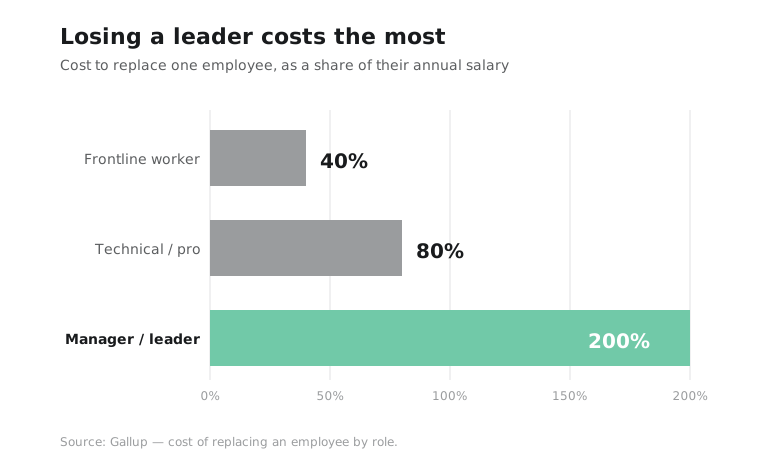
Run that against your own payroll. Lose one $90,000 operations lead and a $70,000 specialist in the same year, and you’re looking at somewhere between $80,000 and a quarter-million dollars in real cost — most of it invisible, all of it coming straight out of the margin you worked so hard to build. Gallup pegs the national bill for voluntary turnover at roughly $1 trillion a year. (Gallup)
The part worth sitting with: most of it is preventable. The Work Institute’s research has consistently found that around three out of four voluntary departures could have been avoided by the employer. (Work Institute) People aren’t leaving because of forces beyond your control. They’re leaving for reasons you could have addressed — if someone had been paying attention.
This is no longer a “tight labor market” excuse
It would be convenient if this were a hangover from the hiring frenzy of a few years ago. It isn’t. The latest U.S. Chamber of Commerce and MetLife Small Business Index, fielded at the end of 2025, found that roughly one in four small business owners (26%) now name attracting or retaining talent as their single biggest challenge — up from 16% just a year earlier. (U.S. Chamber) Concern about attracting talent alone jumped eight points in twelve months.
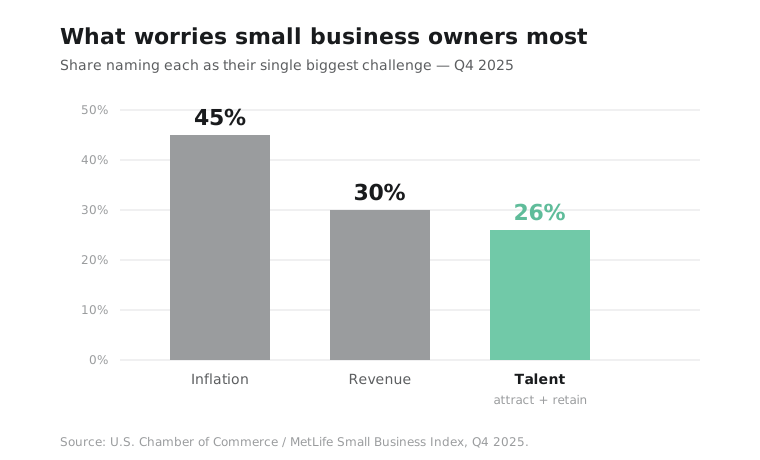
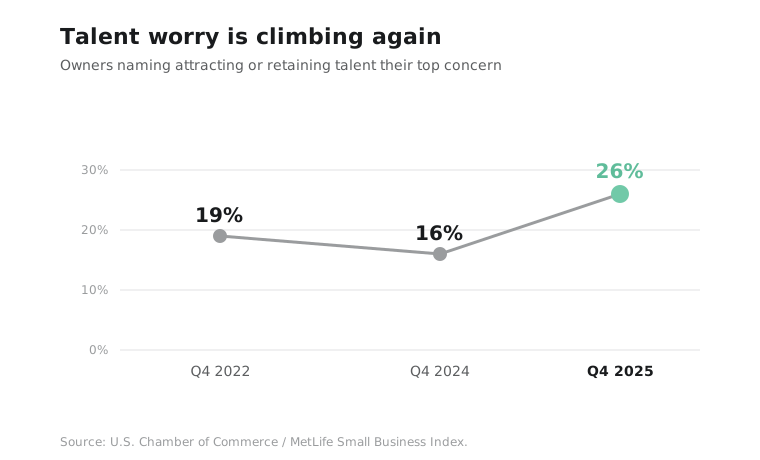
Inflation is still the headline worry for 45% of owners, but talent is the concern climbing fastest. The owners who treat retention as a leadership discipline — not a perks-and-pay arms race — are the ones who’ll stop bleeding their best people while everyone else keeps refilling the same buckets.
What to actually do about it
You don’t fix this with a ping-pong table or a recognition program. You fix it by treating “manager” as a real job that has to be learned, supported, and held to a standard. A few moves that work at your scale:
Stop promoting on production alone. Before you hand someone a team, ask whether they actually want to manage people and whether they’ve shown any instinct for it — patience, the ability to give feedback, genuine interest in someone else’s growth. Being your best producer is a reason to pay someone more, not automatically a reason to make them a boss.
Give your new managers the basics. Most first-time managers in small companies have never been taught how to run a one-on-one, deliver hard feedback, or set clear expectations. A few hours of real coaching — even just a standing weekly conversation with you about how they’re leading, not just what they’re shipping — beats letting them flail and calling it a personality problem when their team falls apart.
Run a stay conversation before the exit interview. Don’t wait until someone resigns to find out what was wrong. Twice a year, every manager should ask their people directly: What would make you think about leaving? What’s frustrating you that I could fix? Three-quarters of departures are preventable, but only if you hear the warning before the two weeks’ notice.
Watch the data, not just the vibes. Which teams churn? Which manager’s direct reports keep “leaving for a better opportunity”? The pattern is almost never random, and it’s usually visible a year before you act on it — if you’re tracking it.
The bench beneath you
Here’s the through-line you may already feel in your gut: the retention problem and the owner-dependence problem are the same problem. The reason you can’t take a real vacation, can’t step back from the day-to-day, can’t sell the business for what it’s worth someday — is that you never built a layer of capable leaders underneath you. And the reason your good people keep leaving is that the layer you did build was assembled by accident.
Building real managers is slow, unglamorous work. It’s also the highest-return thing most owners at your stage are completely ignoring. A company that can keep its best people and run without the founder in the room is worth more, sleeps better, and grows past the ceiling that traps most businesses your size.
At ARV, we sit at the intersection of your numbers and your people — because turnover, margin, and management capacity are the same story told three ways. The financial picture tells you where you’re quietly bleeding; the operational picture tells you which teams and which leaders are driving it. When you’re ready to build a business that doesn’t depend on you to hold it together, that’s the bench we deploy. Beyond accounting means helping you build the layer of leadership that lets you finally step back — and keeps your best people from walking out while you do.