Past the Plateau: Why Growth Stalls Between $5M and $15M, and What Actually Breaks Through
Almost every business that reaches $5M hits a wall the owner can't push through alone. The wall isn't the market or the team. It's the operating model that got you here. How to recognize the plateau early, and the four walls that actually cause it.
You built something most owners never do. So why does every year suddenly feel like the same year?
There’s a moment most successful owners recognize, even if they’ve never said it out loud. Revenue is fine. The team is busy. Customers are happy enough. And yet the business has stopped moving. The number at the end of this year looks suspiciously like the number at the end of last year, and you’re working harder than ever to keep it there.
That’s not a rough patch. That’s a plateau. And it has a structure, which means it can be taken apart.
The plateau is normal. Staying on it is a choice.
First, some perspective on what you’ve already done. Industry analyses of U.S. Census data suggest only around 4-6% of small businesses ever exceed $5 million in annual revenue, and fewer than half of one percent of all U.S. companies ever reach $10 million (PrimePath; Brett Trainor, citing Census data).
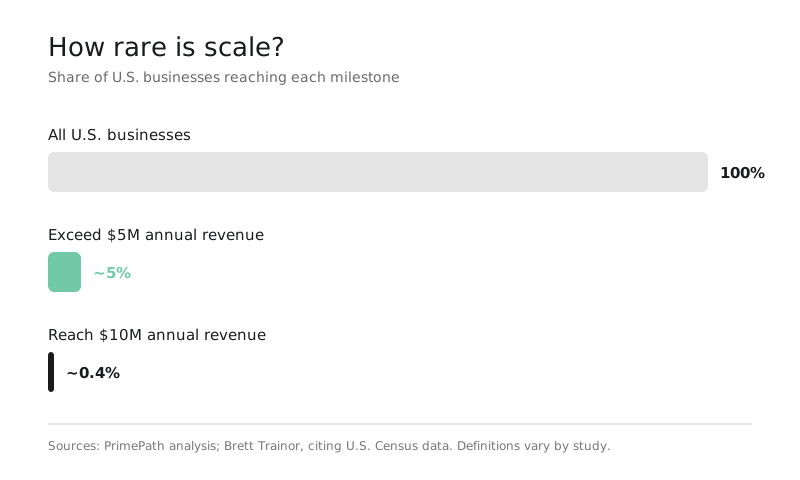
If you’re running a $5M-$15M business, you’re already in rare company. But the data also shows what happens next: among companies that do reach the $10M mark, roughly 60% stall there for three or more years, and only about 40% break through toward $25M (Bullzeye Growth Partners).
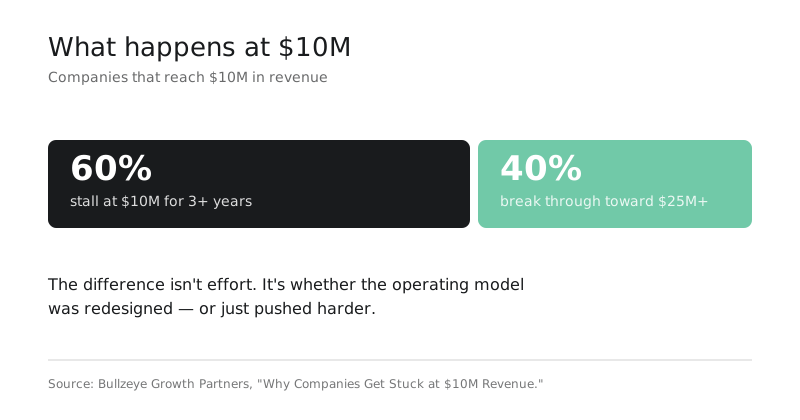
The skills that got a business to $5M (hustle, relationships, founder-led sales, saying yes to everything) are not the skills that get it to $15M. At some point the business stops being limited by effort and starts being limited by design.
The four walls owners hit
In our experience sitting inside businesses at this stage (not advising from the sidelines, actually sitting in the seat), the plateau almost always traces back to one of four walls.
1. The owner is the operating system
Every meaningful decision routes through you. Pricing exceptions, hiring calls, the big customer’s complaint, the bank conversation. You’re not running the business; you’re being the business. The ceiling on a company like that is exactly one person tall.
The tell: take a two-week vacation. If revenue, quality, or morale wobbles, the company has an owner-dependence problem, not a growth problem.
2. Founder-led sales ran out of founder
Most businesses get to $5M on the owner’s network and reputation. Referrals, relationships, repeat work. It’s a beautiful engine with one flaw: it doesn’t scale past your calendar. Research on stalled SMBs consistently finds that growth built on personal networks plateaus when those networks are fully tapped (PrimePath).
The tell: ask what percentage of new revenue last year came from a channel that doesn’t involve you personally. If the honest answer is under 25%, sales hasn’t been built yet. It’s been performed.
3. The second layer of leadership doesn’t exist
Between 10 and 25 employees, a business outgrows the everyone-reports-to-the-owner model. What it needs next is a small number of people who own outcomes, not tasks: someone who owns operations, someone who owns the number. Most plateaued companies have loyal, hardworking managers who were promoted for tenure and still bring every real decision back to the owner.
The tell: count the decisions made last month that you only heard about afterward. Healthy companies at $10M have many. Plateaued ones have almost none.
4. The numbers describe the past instead of steering the future
At this stage most owners still run on a P&L that shows up three weeks after month-end. It tells you what happened. It can’t tell you what to do. Without forward-looking finance (cash forecasting, unit economics, capacity math), every growth decision is a gut call, and gut calls get more expensive as the business gets bigger.
The tell: can you say, today, what happens to cash if you hire two people next month? If the answer requires a weekend and a spreadsheet, the data layer is missing.
What actually breaks the plateau
Here’s the uncomfortable part: none of the four walls is fixed by working harder, and most aren’t fixed by a strategy deck either. They’re fixed by operating differently, usually in this order.
Get the numbers right first. Not because accounting is the goal, but because clean, current, forward-looking financials are the data layer the whole transformation runs on. You cannot delegate decisions, build a sales engine, or hire a leadership layer on top of numbers nobody trusts.
Document how the work actually gets done. The goal isn’t a binder; it’s transferability. Every process that lives only in your head is a brick in the ceiling.
Hire (or borrow) the second layer. Most $5M-$15M businesses can’t yet justify a full-time COO, CFO, and head of sales. They don’t need to. What they need is senior operating capacity pointed at the specific wall that’s binding right now. That might be six months of fractional FP&A, or an operator who builds the sales process and then hands it to a hire the business can actually afford.
Pick one constraint and break it completely. Plateaued companies tend to attack everything at once and move nothing. The companies in that 40% that break through to $25M almost always did the opposite: found the binding constraint, concentrated resources on it, and ignored the rest until it gave.
The plateau is information
A plateau isn’t failure. It’s the business telling you precisely where the current design tops out. The owners who get past it are rarely smarter or harder-working than the ones who don’t. They’re the ones who treated the stall as a diagnosis instead of a verdict.
That’s the work we do at ARV. Accounting is where we start, because the numbers are where the truth lives. But the real product is the bench: operators who’ve sat in your seat, deployed against whatever is actually capping your growth. If this article read less like theory and more like your Tuesday, that’s a conversation worth having.
Sources
- PrimePath, “Why Most SMBs Plateau at $1-5M in Revenue”
- Brett Trainor, “Why 99 out of 100 Businesses Never Reach $10 Million in Revenue” (citing U.S. Census data)
- Bullzeye Growth Partners, “Why Companies Get Stuck at $10M Revenue”
Figures cited are as reported by the sources above; definitions of “small business” and revenue thresholds vary by study.