Everyone's Raising Prices. Almost Nobody Is Pricing.
Tariffs and cost inflation have pushed nearly every owner into raising prices this year. But raising a price and running a pricing strategy are not the same thing — and the gap between them is the single most underused profit lever in your business. Here's how to close it.
Tariffs and stubborn cost inflation have pushed nearly every owner into raising prices this year. But there’s a difference between reacting to your costs and running an actual pricing strategy — and that gap is the most powerful, least-touched profit lever in your business.
Walk into almost any small business right now and you’ll find the same conversation happening. Costs are up, a supplier sent another increase letter, and the owner is staring at a price list trying to decide how much to pass along and how much to eat. It’s the defining operating question of 2026, and most owners are answering it the same way: a little across-the-board bump, sent out reluctantly, hoping nobody notices.
That instinct is understandable. It’s also leaving an enormous amount of money on the table. Because raising a price to cover a cost is not the same thing as pricing — and the businesses that understand the difference are quietly pulling ahead while everyone else plays defense.
The whole market is repricing at once
Start with the backdrop, because it’s unusual and it matters. For most of the last two years, owners raised prices nervously, worried they’d be the only one and lose customers to a cheaper competitor. That worry is now largely gone, because everyone is raising at the same time.
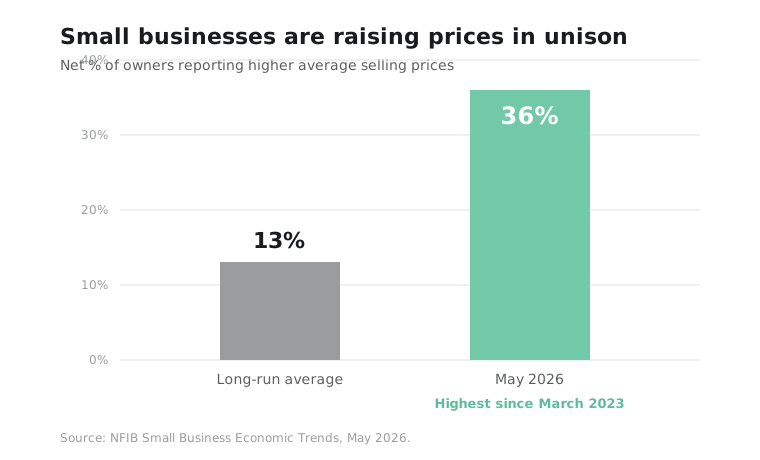
The numbers are striking. In May 2026, a net 36% of small business owners reported raising their average selling prices — the highest reading since March 2023, and nearly triple the long-run historical average of around 13%. A net 34% said they plan further increases in the months ahead, the highest reading on that measure since 2022. (NFIB) This isn’t a handful of businesses testing the water. It’s the whole field moving together.
The pressure behind it is broad. A year into the current tariff regime, KPMG found the share of businesses passing more than half of their tariff costs through to customers had climbed to 34% — more than double the 13% a year earlier — with 55% planning further price increases of up to 15% within six months, and average sourcing costs up more than 25%. (KPMG) Inflation is back at the top of the worry list, too: 18% of small business owners now name it their single most important problem, the highest since late 2024. (NFIB)
Here’s the part most owners miss. When the entire market reprices at the same time, customers expect it. The cover you’ve been waiting for is here. The question is no longer can I raise prices — it’s whether you’re going to do it with a plan or just match your cost increases penny for penny and call it a day.
Why price is the lever that moves everything
There’s a reason pricing deserves more of your attention than almost any other decision you’ll make this year, and it comes down to simple arithmetic that most owners have never seen laid out.
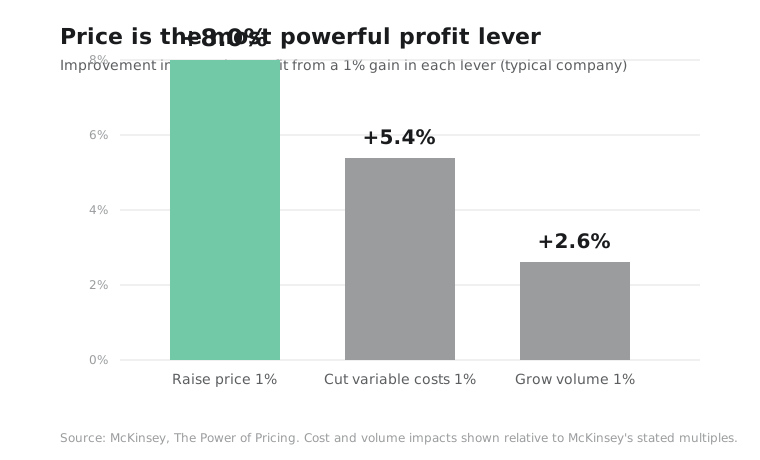
McKinsey studied the operating economics of a typical company and found that a 1% improvement in price, with volume holding steady, lifts operating profit by about 8%. That’s a bigger swing than you’d get from cutting variable costs like materials and labor by the same 1% — and more than three times the impact of growing your sales volume by 1%. (McKinsey) Price flows almost entirely to the bottom line, because the cost of the thing you sold doesn’t change when you charge a little more for it.
Sit with that for a second, because it reframes the whole 2026 problem. Most owners spend the bulk of their energy chasing volume — more leads, more reps, more marketing spend — and squeezing costs, renegotiating with vendors and trimming overhead. Both are hard, slow, and expensive. Meanwhile the single most powerful lever, the one that drops straight to profit, often gets a few hours of attention once a year, usually in a panic when a cost increase forces the issue.
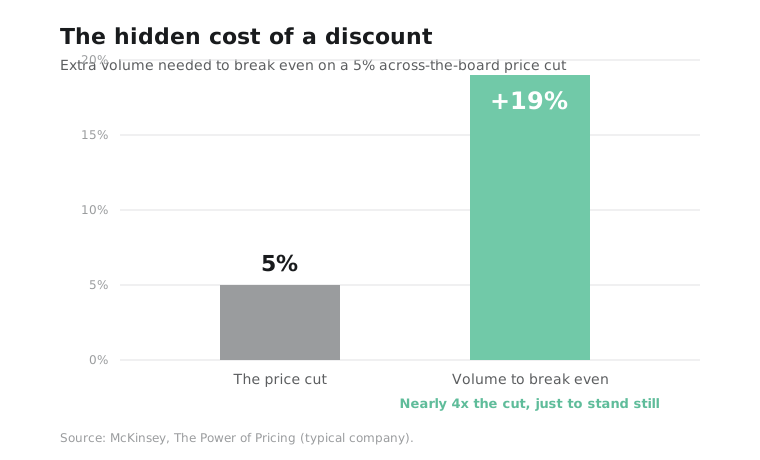
The same math has a warning baked into it. If a 1% price increase adds 8% to profit, a 1% price cut — the discount you wave through to win a deal, the markdown you barely think about — subtracts roughly the same. McKinsey’s analysis found that to earn back the profit lost from a mere 5% price cut, a typical company would need to sell nearly 19% more volume just to break even. Almost nobody who offers a casual discount is selling a fifth more to make up for it.
Reacting to costs is not a pricing strategy
So what does it actually look like to price, rather than just raise prices? The difference is the difference between a thermostat and a thermometer. A thermometer reacts — your costs went up, so your prices go up to match. A thermostat sets a target and manages toward it. Three habits separate the two.
First, they price to the value the customer receives, not to the cost they incurred. Cost-plus pricing — take your cost, add a standard margin, done — is the default at most small businesses because it feels fair and it’s easy to defend. But it quietly caps your upside. It assumes the only thing your price should reflect is what the product cost you, ignoring what it’s worth to the buyer: the downtime it prevents, the headache it removes, the speed you deliver. When a market reprices like this one is, cost-plus owners simply pass the increase along. Value-based owners ask a different question — what is this actually worth to the person buying it? — and frequently find the answer is well above cost-plus.
Second, they stop pricing every customer and every product the same way. Inside almost every business is a spread: some customers are far less price-sensitive than others, and some products carry far more value than their margin reflects. A flat across-the-board increase treats them all identically and leaves the easy money untouched. The owners who do this well segment — premium service tiers, different terms for different customer types, sharper pricing on the products where they’re clearly differentiated and gentler where they’re not. The all-in-one bump is the bluntest tool in the box.
Third, they protect price at the point of sale. Your published price is only a starting point. What you actually keep — the “pocket price” after discounts, concessions, freebies thrown in, and payment terms — is often meaningfully lower, and it leaks one well-meaning exception at a time. The owners who hold their margin aren’t necessarily charging more on paper; they’re disciplined about not giving it away in the room. In a year when every point of margin is under assault from the cost side, the points you surrender at the negotiating table are the ones you can most easily win back.
The window is open — but not forever
The unusual thing about this moment is that the cover for repricing won’t last indefinitely. Right now customers expect increases, competitors are all moving, and a thoughtful price change blends into the broader shift. As cost inflation eventually cools and the market settles, that permission narrows again, and the owners who used this window to genuinely reset their pricing — to value, by segment, with discipline — will be operating from a structurally higher baseline than the ones who just chased their costs.
The cost increases on your desk are real and they aren’t going away. But they’re also the prompt for a better question than “how much do I pass along?” The better question is the one a thermostat asks: what should this actually be worth, to this customer, in this market? Answer that one well and pricing stops being the thing you dread every quarter and becomes the most reliable profit lever you own.
At ARV we start with the numbers — your real margins, customer by customer and product by product — because that’s where the pricing conversation has to begin. But the work doesn’t end at the spreadsheet. Setting price to value, segmenting your book, and holding the line at the point of sale are operating decisions, and we bring the operators to help you make them. That’s what we mean by beyond accounting: the bench is here when you’re ready to stop reacting to your costs and start pricing on purpose.
Sources
- NFIB Small Business Economic Trends, May 2026 — net percent of owners raising average selling prices, plans to raise prices, and inflation as top problem. nfib.com
- KPMG 2026 Tariff Survey (March 2026) — share of businesses passing more than half of tariff costs to customers, planned price increases, and rising sourcing costs. kpmg.com
- McKinsey & Company, The Power of Pricing — profit impact of a 1% price improvement versus cost and volume levers, and the volume required to offset a price cut. mckinsey.com