You're Still the Best Salesperson You Have. That's the Problem.
Most owners between $5M and $15M are still the engine of their own sales — and the first salesperson they hire usually fails. The data shows why, and it's almost never the hire. It's what wasn't built before they arrived. Here's the sequence that works.
You built the business on your own relationships, your own pitch, your own read of the room. That worked — right up until it became the ceiling. The first sales hire is supposed to fix it. Usually it doesn’t, and the reason has almost nothing to do with the person you hired.
Here’s a scene we’ve watched play out in business after business. The owner has grown the company to $7M, maybe $11M, largely on their own back. They are the best salesperson in the building — by a wide margin, and not by accident. Every meaningful deal still routes through them. They know it’s a problem. They’re the bottleneck on growth, they can’t take a real vacation, and the whole enterprise has a single point of failure wearing their shoes.
So they do the obvious thing. They hire a salesperson. Someone senior, someone with a book of business, someone to take the load off. And six to twelve months later that person is gone, the pipeline looks the same as it did before, and the owner has quietly concluded that “salespeople don’t work for a business like ours.”
The conclusion is wrong. But the experience that produced it is very real, and the data backs it up.
The first sales hire usually fails
The clearest numbers we’ve seen on this come from a benchmark of more than 100 agencies, but the mechanism applies far beyond agencies — to any owner-led business where the founder has been the rainmaker. In that study, 55% of first sales hires lasted less than a year, and only 9% met or exceeded their revenue quota (Haus Advisors, 2025 Agency Sales Maturity Benchmark). Put the other way: 91% missed.
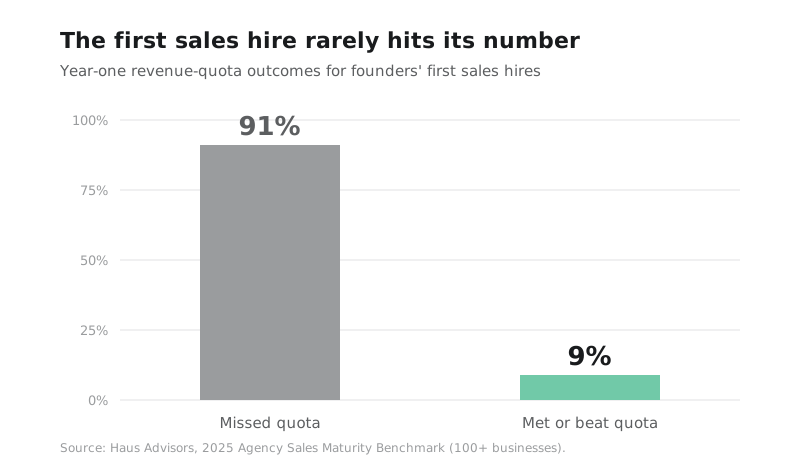
Read that again, because it’s easy to file under “hiring is hard” and move on. Nine out of ten of these hires fail to hit their number in year one. That is not a normal failure rate for a senior professional role. Something structural is going on — and once you see it, you can’t unsee it.
It’s almost never the hire
When that same benchmark looked at the businesses where the first hire succeeded, the difference wasn’t the salesperson’s résumé, vertical, or years of experience. The pattern held across all of those. The difference was what existed before the hire walked in the door. Three things, specifically, were missing in the businesses where hires failed:
There was no positioning the hire could actually use. Most owners can articulate what they do brilliantly — in the moment, on a call, drawing on a decade of context. But it lives in their head. When the value proposition has never been written down in a way a newcomer can deliver without the founder in the room, the salesperson is forced to improvise the pitch on every call. That’s the founder’s skill. The hire doesn’t have ten years of pattern recognition to fake it.
There was no lead flow that didn’t run through the owner. In the benchmark, 82% of businesses relied on referrals and word-of-mouth as their primary source of new business (Haus Advisors). Referrals are the owner’s asset, not the company’s — they flow through the owner’s personal network and relationships the new hire simply doesn’t have. Drop a salesperson into a business with no independent lead source and you’ve handed them an empty calendar and a quota. Of the 9% who hit their number, nearly all worked somewhere with at least one non-referral channel producing conversations before they arrived. In zero cases did the hire successfully build that channel from scratch.
There was nothing productized to sell. Only 27% of the businesses studied had a documented sales script or repeatable offer; the other 73% custom-scoped every deal in real time (Haus Advisors). Custom scoping requires the owner’s judgment and pricing instinct. With nothing standardized to put in front of a prospect, the new hire either pitches vague capabilities or punts every quote back to the owner — which makes them an expensive appointment-setter, not a closer.
Stack those three gaps together and the math is brutal. The salesperson can’t explain what you do, has no one to call, and has nothing concrete to sell. Even a great one will spend their first six months reverse-engineering your business instead of selling it — and you’re paying a sales salary for what is really discovery work.
The instinct is right. The sequence is wrong.
The urge to get sales off your plate is correct. Growth past the plateau genuinely does require taking the company off your personal relationships. The mistake is sequencing: hiring the salesperson first and hoping they’ll build the foundation, when the foundation is what makes the salesperson possible.
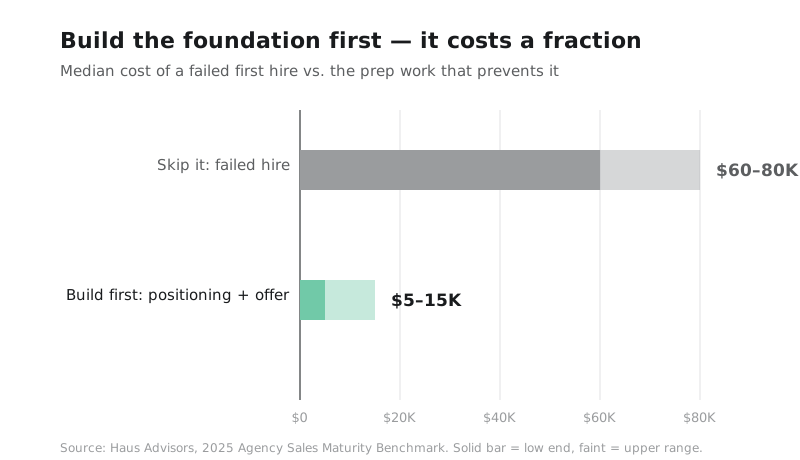
And the cost of getting the sequence wrong is not small. In the same benchmark, the median cost of a failed first hire — comp, benefits, and ramp over the six to twelve months before they left — ran roughly $60,000 to $80,000. The positioning and productization work that would have set them up to succeed ran $5,000 to $15,000, done in a few weeks (Haus Advisors). You can spend a little to build the runway, or a lot to discover you didn’t have one.
The talent market makes the wrong sequence even more expensive. As of late 2025, half of small businesses that were hiring reported few or no qualified applicants for their open roles, and a third had openings they simply couldn’t fill (NFIB Jobs Report). When good salespeople are this hard to find and keep, you cannot afford to burn one on a role that was never set up to win. A bad first experience also poisons the well: the owner concludes hiring doesn’t work, stays the bottleneck, and the ceiling holds.
What to build before you hire
You don’t have to postpone hiring forever. You have to do roughly a month of unglamorous work first. Here’s the sequence we’d run with an owner in your seat.
Write the positioning down. One page: who you serve, the specific problem you own, why a prospect should pick you over the obvious alternatives. Test it by handing it to three people outside your company. If they can immediately tell you who you’re for and what you solve, it’s done. If they ask clarifying questions, it isn’t — and neither will your future hire be able to.
Build one lead source that isn’t you. It doesn’t need volume. A single partnership or referral engine that reliably produces three to five real conversations a quarter — that runs without your personal Rolodex — is enough to give a new hire something to manage and a way to prove their value. The point is that it exists independently of your phone.
Productize one offer. Take your most repeatable engagement and pin it down: scope, deliverables, timeline, price, on one page. Give your hire something they can present, that a prospect can evaluate without ambiguity, and that your team can deliver without pulling you into every deal.
Put a number on it. Most growing businesses now run a CRM — adoption among small businesses sits around 71% (CRM.org) — but the tool only matters if the pipeline is visible and the activity is tracked. Before you hand sales to someone else, you need to see the funnel the way you’ll need to manage it: leads in, conversations had, deals out. You can’t delegate what you can’t measure.
Do these four things and the hire stops being a coin flip. You’re no longer asking a stranger to reinvent your business. You’re handing them a working engine and asking them to drive.
We’ve sat in your seat
The hard part isn’t knowing the foundation matters. It’s that the owner doing $9M is the worst-positioned person to step out of sales long enough to build it — because they’re the one running every deal. That’s the trap. Working in the sales function makes it nearly impossible to work on it.
That’s the gap ARV exists to fill. We’re a business transformation firm built on a foundation of accounting, which means we start from your actual numbers — what your pipeline is really worth, where margin lives, what a sales hire would have to produce to pay for itself — and then we deploy operators who’ve built sales engines before to do the work alongside you. Not a deck with recommendations. People who write the positioning, stand up the first repeatable lead source, and productize the offer, so that when you do hire, you’re handing over something that works.
If your growth runs through your own calendar, the next salesperson isn’t your answer. The foundation underneath them is. That’s the part we’d build with you — beyond accounting.
Sources
- Haus Advisors, 2025 Agency Sales Maturity Benchmark — first-hire outcomes, referral dependence, productization gaps, and cost figures: hausadvisors.com
- NFIB Jobs Report (December 2025 release) — unfilled openings and qualified-applicant shortage: nfib.com
- CRM.org — small business CRM adoption: crm.org