Stop Hiring Heroes
The qualified-worker shortage is real — 84% of owners trying to hire this summer can't find good candidates. But most $5M–$15M businesses aren't short on people. They're short on roles an ordinary good employee can actually win in. Here's the more durable fix.
The qualified-worker shortage is real. But most owners are trying to solve a design problem with a job posting — and the posting keeps losing.
If you tried to hire this summer, you already know the number in your gut. In June, 84% of the small business owners who were hiring or trying to hire said they found few or no qualified applicants for the roles they needed to fill — the highest reading since September 2024, according to the NFIB’s June 2026 Jobs Report. Nineteen percent of all owners now name “labor quality or availability” as their single most important problem, up six points in a month and the highest that gauge has run since December 2016.
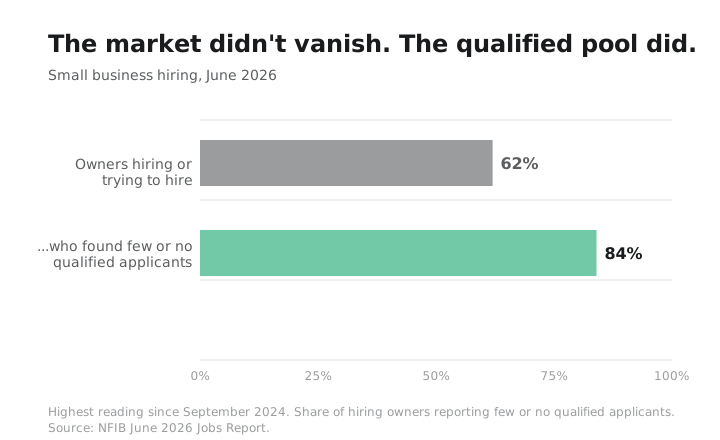
So the instinct is to blame the pool. The applicants are worse. The good ones want too much. Nobody wants to work. Some of that is true on the margins. But if you’ve been searching for the same role for four months, the harder question isn’t where are the good people — it’s what exactly am I asking one person to be?
Because a lot of the time, the answer is a hero. And you can’t recruit your way to a hero on a schedule.
The role you can’t fill is usually a role you designed for a unicorn
Here’s the pattern we see over and over in businesses between $5M and $15M. The company grew on the backs of a few exceptional people — including, often, the owner. Those people absorbed complexity. They did three jobs, held the tribal knowledge, fixed the messes nobody documented, and never really needed training because they’d been there since it was small.
Then one of them leaves, or you finally try to add capacity, and you write a job description that quietly describes that person. Runs operations and does the quoting and manages the crew and knows the software and never drops a ball. You’re not hiring for a role. You’re hiring for a rescue.
The market for rescuers is thin and expensive, and when you do find one, the stakes are brutal. The U.S. Department of Labor pegs the cost of a bad hire at at least 30% of that employee’s first-year earnings — and that’s the conservative floor. SHRM puts the true cost of replacing an employee at 50% to 200% of their annual salary, with the average replacement now running roughly $56,500 and the average role taking 42 to 44 days to fill. In a 15-person company, one wrong senior hire doesn’t dent the year. It is the year.
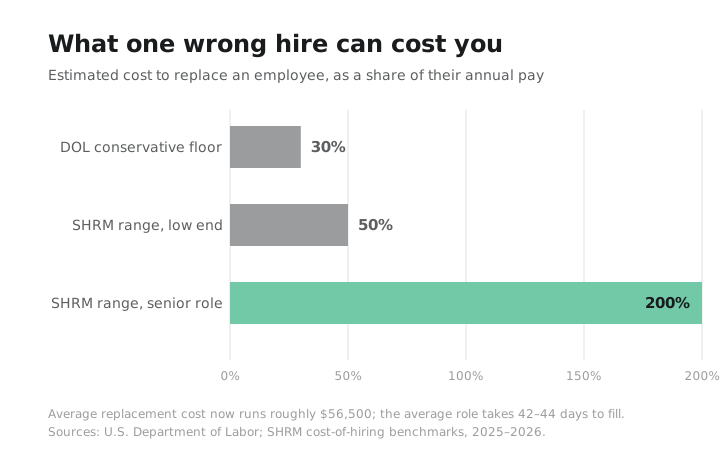
So the hero role fails twice. It’s the hardest role to fill, and it’s the most expensive one to get wrong.
The shift: design the job before you post it
The owners who get unstuck stop treating this as a recruiting problem and start treating it as an operations problem. The move isn’t to search harder for someone extraordinary. It’s to redesign the role so a good, ordinary, hireable person can win in it.
That sounds obvious and it is genuinely hard, because it means doing the work the hero was quietly doing for you. Three steps, in order:
Write down what the role actually does. Not a title — the real list. If the honest answer is “eleven unrelated things,” you haven’t found a person, you’ve found a symptom. Split it. Two solid hires who each own something clear will out-perform one mythical hire who owns everything and burns out by spring.
Build the onboarding the hero never needed. The reason your last great employee “just got it” is that they built the knowledge over years and kept it in their head. A normal new hire needs it on paper: the checklist, the standard, the “here’s how we actually do a quote.” A role a stranger can learn in 30 days is a role you can fill from a much bigger pool.
Define what good looks like — in numbers. Give the seat a scorecard: the three or four outcomes that mean this person is succeeding by day 90. When the bar is a set of results instead of a vibe, you stop needing someone who reminds you of your best employee and start being able to judge whether a real candidate can hit real targets.
None of this is HR poster material. It’s the same operating discipline you’d apply to a pricing problem or a margin problem. You’re taking something that only worked because of one irreplaceable person and turning it into something the business owns.
Build the bench you already have
There’s a second door most owners walk right past while they’re staring at the job boards: the people already on payroll.
The math on this is lopsided in your favor. Research from Wharton’s Matthew Bidwell found that external hires are paid 18% to 20% more than internally promoted people doing the same job — and are significantly more likely to be let go in their first two years. Internal moves are cheaper, faster, and stickier: LinkedIn’s data shows employees stay 41% longer at companies with high internal mobility than at companies where the only way up is out.
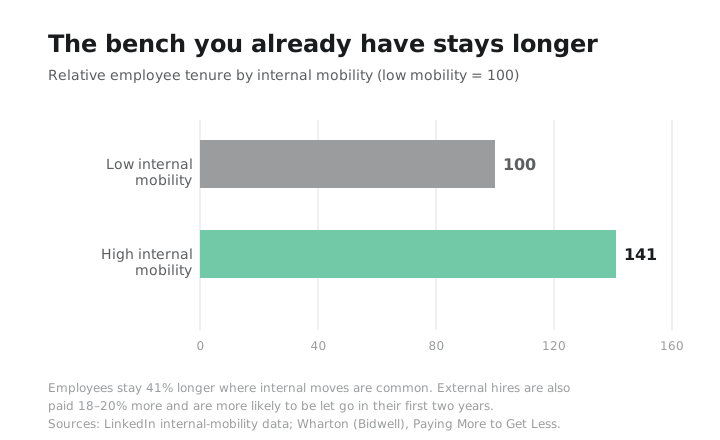
An outside hire is a bet on a stranger’s résumé. Promoting the person who already knows your customers, your systems, and your standards is a bet on someone whose work you’ve watched for two years. In a tight market, that’s not a consolation prize — it’s the better trade. The catch is that it only works if you’ve built the onboarding and the scorecard above, because promoting someone into an undefined hero-role sets them up to fail too.
What this looks like on Monday
Pick the one role you’ve been unable to fill — the search that’s dragged on longest. Before you renew the posting, do three things. Write out everything that role really does and ask whether it’s honestly one job or two. Spend an hour capturing the parts a new person couldn’t learn without a hero in the room, and put them on paper. Then look at your current team and ask, for real, whether someone already inside could grow into part of it with a defined runway.
You may still need to hire. The shortage is real, and some seats genuinely require someone new. But you’ll be hiring for a role a normal excellent person can fill — not waiting on a rescuer who isn’t coming.
The hiring market isn’t going to loosen because you want it to. What you can change is whether your growth stays hostage to finding one more exceptional person. That’s the difference between staffing and building — and building is the part you control.
At ARV, this is the work behind the work. We start in the numbers — what each role actually costs you, where the business breaks when one person is out — and then help owners design the roles, systems, and bench that let the company run on more than heroics. Beyond accounting means deploying the bench so you don’t have to be the bench. When you’re ready to stop waiting on a unicorn, we should talk.
Sources
- NFIB — June 2026 Jobs Report (PDF)
- NFIB — Small Business Job Openings Rebound, June 2026
- U.S. Department of Labor / SHRM — cost of a bad hire
- SHRM — cost-of-hiring benchmarks, 2025–2026
- Wharton (Matthew Bidwell) — Paying More to Get Less: External Hiring vs. Internal Mobility (PDF)
- LinkedIn internal-mobility retention data (via Gloat)