Tariffs Are Your New Weather. Stop Waiting for the Storm to Pass.
Most owners are treating tariffs like a bad storm — brace, absorb the hit, wait for it to clear. But cost volatility isn't weather anymore. It's climate. The businesses pulling ahead stopped reacting to each announcement and built a repeatable system for defending margin. Here's what that looks like.
yet-76-still-expect-growth-fora-financial-survey-finds-302756261.html”
- title: “Q1 2026 Small Business Economic Outlook Report — Revenued” url: “https://www.revenued.com/q1-2026-smb-report”
- title: “KPMG 2026 Tariff Survey: Declining Margins as 55% Plan Further Price Increases” url: “https://kpmg.com/us/en/media/news/kpmg-2026-tariff-survey.html”
Tariffs Are Your New Weather. Stop Waiting for the Storm to Pass.
Most owners are managing tariffs like a bad storm: brace, absorb the hit, wait for it to clear. But the last eighteen months have made one thing obvious — cost volatility isn’t weather anymore. It’s climate. The companies pulling ahead stopped reacting to each headline and built a system for it.
Ask a room full of business owners how tariffs are going and you’ll hear some version of the same story. A supplier sent a price letter. Margin took a hit. Nobody wanted to be the one to raise prices, so for a while you ate it. Then you raised prices anyway, quietly, hoping customers wouldn’t notice. And underneath all of it: the expectation that at some point this settles down and things go back to normal.
They don’t go back to normal. That’s the part worth sitting with.
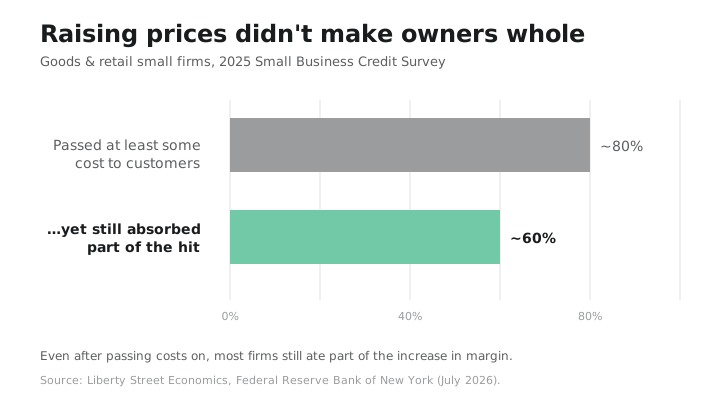
The data now backs up what your P&L has been telling you. In the Federal Reserve Bank of New York’s most recent small-business survey, roughly 80% of goods and retail firms said their imported input prices went up, and about 80% passed at least some of that cost on to customers. Here’s the number that matters, though: of the firms that raised prices, about 60% still absorbed part of the increase through thinner margins. Raising prices didn’t make you whole. It just made the wound smaller. (Liberty Street Economics)
That’s the quiet trap of the “weather” mindset. You treat each price letter as a one-off, you make a one-off decision to eat it or pass it, and you never build the muscle to do this well — because you keep believing you won’t have to do it again.
The gap between reacting and responding
There’s a version of a business that reacts, and a version that responds. They look similar from the outside. They are not the same company.
The reactive business finds out about a cost increase when the invoice arrives. It decides what to do about pricing in a hallway conversation. It has one supplier for the thing that matters most, and no idea what the second-best option costs. When margin slips, it finds out at the end of the quarter — from the accountant, after the fact, when the only options left are bad ones.
The responsive business assumes the cost increase is coming. It knows, before the letter arrives, which products can carry a price increase and which can’t. It has a second supplier qualified and ready, even if it’s a little more expensive, because optionality is worth paying for. And it watches margin by product or job in something close to real time, so a slip shows up as a small correction in week three instead of a nasty surprise in week thirteen.
The difference isn’t sophistication or size. It’s whether you decided in advance that this is a permanent condition and built a small amount of standing infrastructure to handle it. That’s the whole game.
Owners are more optimistic than their margins
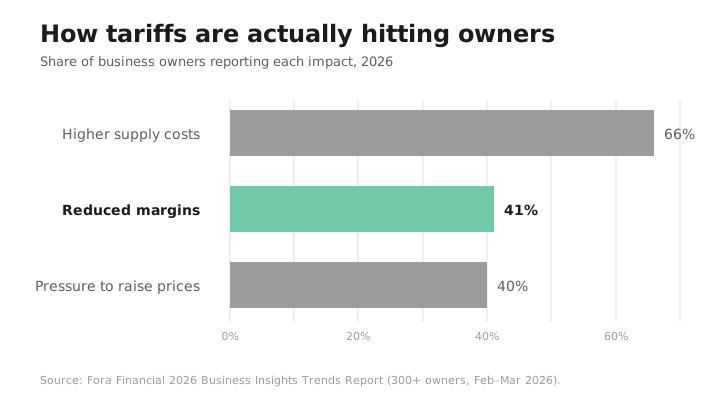
Here’s what’s strange about this moment. Owners are getting hit and staying optimistic at the same time. In Fora Financial’s 2026 survey of more than 300 business owners, 73% reported some impact from tariffs — most commonly higher supply costs (66%), reduced margins (41%), and pressure to raise prices (40%). And yet 76% still expected to grow. (Fora Financial)
Optimism is a good trait in an owner. But optimism without a system is just hope with a nicer name. The risk isn’t that you’re too positive — it’s that positivity lets you defer the boring structural work that would actually protect the growth you’re counting on.
Because the cushion is thinner than the optimism suggests. In a separate February 2026 survey of 307 owners, nearly two-thirds — 62.9% — said they had less than three months of operating cash if revenue slowed. Three in four said their costs were higher than a year earlier. And of the 61% who went looking for financing, more than half were turned away or left unsure they’d qualify. (Revenued) That’s the real exposure. A margin hit you can absorb this quarter becomes a serious problem the quarter a big customer pays late, because there’s no reserve behind it.
What a response system actually looks like
None of this requires a consulting deck or a reorg. For a $5M–$15M business, a working response to cost volatility comes down to four unglamorous habits.
Know your pass-through map before you need it. Sit down — once — and sort your products, services, or jobs into three buckets: where you have room to raise price and customers won’t flinch, where you have some room if you’re careful, and where you have none. When the next cost increase lands, you’re not debating from scratch. You already know where it goes. Most owners have this map in their head but have never made it explicit, which means nobody else in the business can act on it.
Qualify a second source for anything that matters. Single-supplier dependence is the thing that turns a cost increase into a hostage situation. You don’t have to switch. You just have to have somewhere else to go, with a known price, so your current supplier’s next letter is a negotiation and not an ultimatum. Even large companies have learned this the hard way — KPMG found the share of big firms passing on more than half their tariff costs doubled to 34% in a year, and 55% planned further price increases within six months. (KPMG) When your suppliers are raising prices and planning to raise them again, you want alternatives on the bench.
Watch margin where it actually lives — by job, not by month. A monthly P&L tells you margin eroded after it’s already gone. Margin by product line or by job tells you which thing is bleeding while you can still do something about it. This is the single highest-leverage change most owners can make, and it’s usually a reporting problem, not a data problem. The numbers exist. They’re just not being cut the way you’d need to see the trouble coming.
Price on a schedule, not on an emotion. The reason price increases feel awful is that owners save them up until the pain is unbearable, then move all at once and brace for the customer reaction. Companies that review pricing on a set cadence — quarterly, against real costs — make smaller, calmer, more frequent moves that customers absorb without drama. You stop dreading the conversation because you’re no longer having a dramatic one.
The point isn’t tariffs
Tariffs are this year’s version of the pressure. Next year it’s something else — a freight spike, an insurance renewal that doubles, a key input that gets scarce, a wage floor that moves. The specific storm is never the point. The point is whether your business has a standing way to sense a cost shift early, decide what to do about it without a fire drill, and act before the margin is already gone.
That’s not a tariff strategy. It’s just running a business that’s built for the climate it actually operates in — one where costs move, often, and don’t ask permission.
The owners who internalize that stop losing sleep over each announcement. Not because the announcements stopped mattering, but because they built the thing that handles them. The weather still comes. They’re just no longer standing out in it.
Beyond accounting
At ARV, we start with the numbers — margin by job, cash runway, the pricing map — because that’s the foundation. But the response system that protects those numbers is an operating problem: sourcing, pricing discipline, the reporting that surfaces trouble early. That’s the bench we deploy. If cost volatility keeps eating margin you can’t seem to get back, let’s build the system that catches it before the quarter closes — not after.
Sources
- Effect of Tariffs on U.S. Small Businesses — Liberty Street Economics, Federal Reserve Bank of New York (July 2026)
- 73% of Businesses Hit by Tariffs — Yet 76% Still Expect Growth, Fora Financial 2026 Business Insights Trends Report
- Q1 2026 Small Business Economic Outlook Report — Revenued (February 2026, 307 owners)
- KPMG 2026 Tariff Survey: Declining Margins as 55% Plan Further Price Increases