Most Businesses Never Sell. Yours Doesn't Have to Be One of Them.
70-80% of businesses listed for sale never find a buyer, and nearly 90% of the average owner's wealth is locked inside the company. The work that makes a business sellable is the same work that makes it better to own. Start years before you think you need to.
Somewhere between 70 and 80 percent of businesses put up for sale never find a buyer. The owners didn’t fail at selling. They failed, years earlier, at building something separable from themselves.
Every owner exits. That’s the one certainty in business ownership nobody likes to discuss. You’ll sell to a buyer, hand it to family, transfer it to your team, or close the doors, but you will leave, and the only open question is whether you leave on your terms.
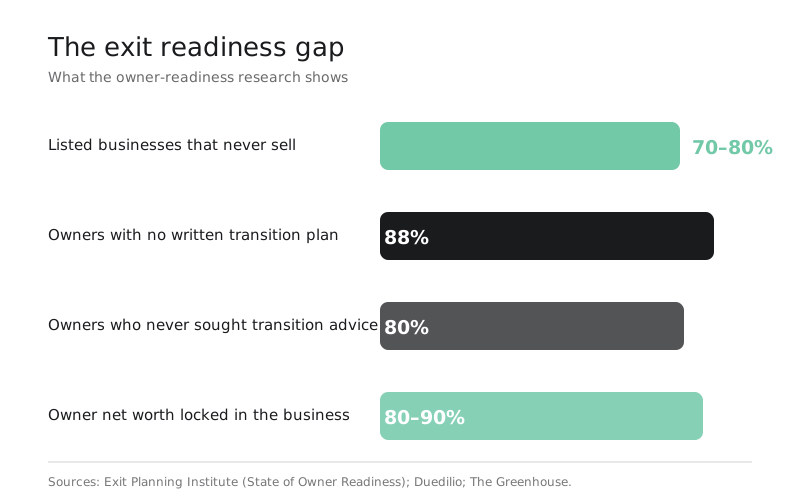
The data on how this usually goes is sobering. Industry analyses consistently put the share of listed businesses that never complete a sale at 70-80% (Duedilio; The Greenhouse, citing Exit Planning Institute research). The Exit Planning Institute’s owner-readiness research explains why: roughly 88% of owners have no written transition plan, and 80% have never sought advice about transitioning at all (Exit Planning Institute).
Now stack one more number on top: for the typical owner, 80-90% of personal net worth is locked inside the business (Exit Planning Institute). Most owners’ retirement isn’t in a brokerage account. It’s in the company, an asset most of them have never valued, never prepared for sale, and statistically will struggle to sell.
Why good businesses don’t sell
Here’s what surprises owners most: businesses that fail to sell are usually not bad businesses. They’re profitable, respected, full of loyal customers. What they aren’t is transferable. A buyer isn’t purchasing your revenue; they’re purchasing the machine that produces it, and if the machine is you, there’s nothing to buy.
The patterns that kill deals show up again and again:
The owner is the business. Top customer relationships, pricing decisions, key supplier terms, all routed through one person who’s leaving. Buyers call this key-person risk, and they respond with brutal discounts, long earnouts that chain you to the desk for years, or a polite pass.
The numbers can’t survive diligence. Cash-basis books, personal expenses mixed in, revenue that can’t be tied cleanly to contracts. Every surprise a buyer finds in diligence costs you twice: once in price, once in trust. Deals rarely die in one dramatic moment; they bleed out through small discoveries.
Customer concentration. One customer at 30%+ of revenue reads, to a buyer, as one phone call away from a different business.
The team won’t survive the transition. No second layer of leadership, no documented processes, key employees with no reason to stay. The buyer isn’t just discounting the business. They’re pricing the rebuild.
If you’ve read our piece on why growth stalls between $5M and $15M, this list should look familiar. The walls that cap growth and the flaws that kill sales are the same flaws. That’s the most useful insight in all of exit planning.
Sellability is just quality you can prove
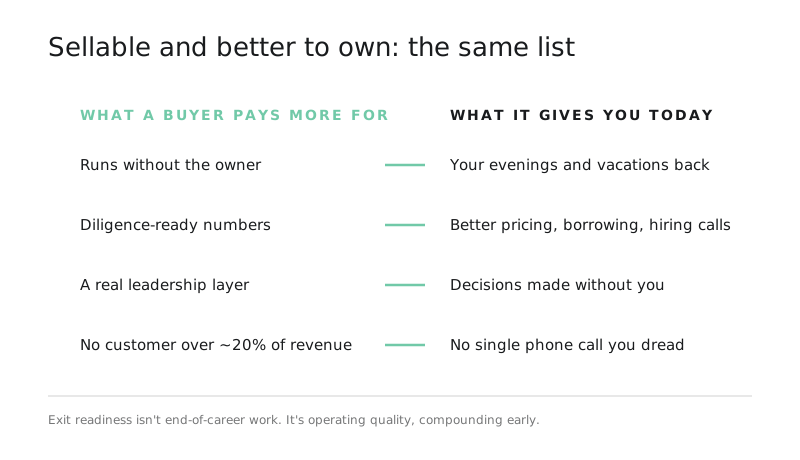
Because here’s the reframe that changes the conversation: the work that makes a business sellable is exactly the work that makes it better to own.
A business that runs without daily owner heroics is more valuable to a buyer, and gives you your evenings back now. Books that would survive diligence also support better pricing, borrowing, and hiring decisions today. A leadership layer that lets a buyer sleep at night lets you take a real vacation this summer. Lower customer concentration means less terror when any one phone rings.
None of this is “exit work” you do at the end. It’s operating quality, compounding for years before any buyer appears, which is why the owners who win at exit are almost never the ones who started preparing when they got tired. They’re the ones who built a sellable company and then chose when to sell it.
The three-year head start
Advisors across the industry converge on the same rule of thumb: a well-prepared exit takes two to five years, not two to five months. If you’re 50 and imagine selling “around 60,” the preparation window opens sooner than you think. Here’s the honest sequence:
Year one: face the numbers. Get an objective sense of what the business is worth today and, more important, why. What’s driving the multiple, and what’s dragging it? Move the books to a standard a stranger could trust. This step costs the least and changes the most, because every later decision keys off it.
Year two: attack the discounts. Key-person risk, customer concentration, missing leadership, undocumented process: pick the one a buyer would discount hardest and fix it like a project, not a wish. This is operating work. It usually needs operating help.
Year three and beyond: build the option. With clean numbers and reduced risk, you now have something rare: choices. Sell to a strategic buyer, take on a partner, transition to management, or simply keep owning a company that no longer needs you every day. The point of exit readiness was never the exit. It was the option.
Don’t be the 88%
The statistics at the top of this article aren’t destiny. They’re a portrait of inaction. The 70-80% of businesses that never sell mostly belong to the 88% of owners who never wrote a plan and the 80% who never asked for help.
This is the seat ARV was built for. Accounting is the foundation (diligence-ready numbers are where every good exit starts), but the real work is operational: making the business separable from you, one system and one hire at a time. Our bench has sat in the owner’s seat and the buyer’s seat both. Whether your exit is two years away or ten, the best time to start is while it’s still a choice.
Sources
- Exit Planning Institute, “Owner Readiness: What It Is & Why Should You Care?” (State of Owner Readiness research)
- Duedilio, “Business Sale Failure Rate: Why 80% Don’t Sell”
- The Greenhouse, “Why 70-80% of Businesses Never Sell” (citing Exit Planning Institute research)
Figures are as reported by the sources above; sale-completion rates vary by business size, industry, and market conditions. Nothing here is legal, tax, or investment advice. Talk to your advisors about your specific situation.